
































































































Verified Platforms
Quick Links
Where to Stay Secure
Thank you! Your submission has been received!
Oops! Something went wrong while submitting the form.


Your win rate is the first number you check, and the one that lies to you the most. Ask what makes a good trader and you will point at it before anything else, because it is simple, it is yours, and it feels like a grade. Then you finish a week up on more trades than you lost, you open the balance expecting it to agree with the percentage, and it does not. The winners were small and frequent. One loser was not. Between the number you are proud of and the money you actually kept, a whole trading identity went unmeasured, and a single percentage has nowhere to put it.
This is a walkthrough with Ava, the Kodex Faculty voice who reads structure and geometry. She looks at a run of trades and sees the shape they make, not the score they post. She works the way the platform's Pattern Intelligence does: ten dimensions, read from what you already did, not one figure you can round up.
Ava does not start with your win rate. She starts with two accounts that share it.
Put them side by side. Both won forty of their last hundred trades. On paper they are the same person with the same edge, and a win-rate column would file them under the same verdict. Watch what they actually did and they are not in the same profession.
The first account ran its winners and kept its losers small: forty wins carried to two and a half times the risk taken, sixty losses cut at one. It compounds. The second did the reverse, banking profits early and giving losses room to breathe in hope, the pattern behavioral economists named the disposition effect. Same forty percent on the scoreboard, and the account bleeds.
Now turn it around. A sixty-percent win rate feels like a good trader by definition. Win small and lose big, though, and you can be right six times out of ten and still hand the account back by Friday. The percentage you are proud of is telling you how often you are right. It is silent on whether being right is paying you.
A win rate is one axis. Your trading happens on ten. Ava's word for the distance between those two facts is geometry: one number is a point, and a point cannot show you a shape. Plot the same behavior across more than one axis and the thing you could not explain on the balance line becomes obvious.
Even the numbers built to repair win rate are still one axis standing in for many. The Sharpe ratio adjusts return for how much risk you took to earn it, which is sharper than a raw percentage. It still compresses a whole trading life into one score you cannot take apart.
Compression is the problem, not which number you compress into.
Pattern Intelligence, the read behind the Kodex simulator, scores ten of these axes instead. Not a questionnaire you fill in. Not how you felt on a good day. The dimensions come out of what you already did, read from your simulated trading history, trade after trade. Ten is a lot to hold at once, so they fall into three groups: how you move, what you keep, and what sits underneath both. None of them is your win rate. Your win rate is a downstream result of all ten.
Start with the ones you could almost feel in the moment, if you ever stepped back to watch yourself trade.
Trade Frequency is how often you fire. Read alone it looks like activity. Read against your results it tells you whether you are trading a plan or trading boredom, and the trap is counting more trades as more work done.
Time Horizon is how long you stay in. This is where cutting winners early and holding losers late stops being a bad day and shows up as a habit with your name on it. Ignore this axis and you will keep blaming your entries for what your exits are doing.
Asset Spread is how wide you range: one pair you understand cold, or twelve you are half-watching because they moved this morning. Concentration can be mastery or it can be a blind spot, and the count alone will never tell you which. Only the count set against your results will.
Execution Complexity is how involved each trade is, from a plain market order to layered entries with scaling and staged stops. More moving parts can mean more skill, or a way to feel busy while dodging one simple decision. Complication is not edge, though it wears the costume well.
Risk Tolerance is how much heat you take per position. Too little and every winner is capped before it can matter. Too much and one ugly session erases a careful month. It is the dimension that most often hides inside a healthy-looking win rate, which is exactly why the win rate cannot warn you about it.
Risk-Reward Mastery is the size of what you win measured against the size of what you lose. This is the axis that turns a forty-percent win rate into a compounding account or a slow bleed. Your win rate tells you how often you are right. This tells you whether often is enough to survive the times you are wrong.
Profitability is whether the whole machine actually nets out once fees, costs, and the losers are counted, not whether your last trade printed green. A run of wins can sit on top of a system that loses across a full sample. This is the dimension that refuses to be flattered.
Consistency is whether your results come from a process you can repeat or from a few outliers you could never reproduce. One enormous trade can carry a quarter and teach you nothing you can use again. A good month is not the same as a good method, and only this axis knows the difference.
Foundation is how much of what you do rests on understanding versus imitation, whether you can say why a setup works or only that it worked last time. It is the quietest dimension and the one that decides whether the other nine improve or just churn in place. Skill you cannot explain is luck you have not lost yet.
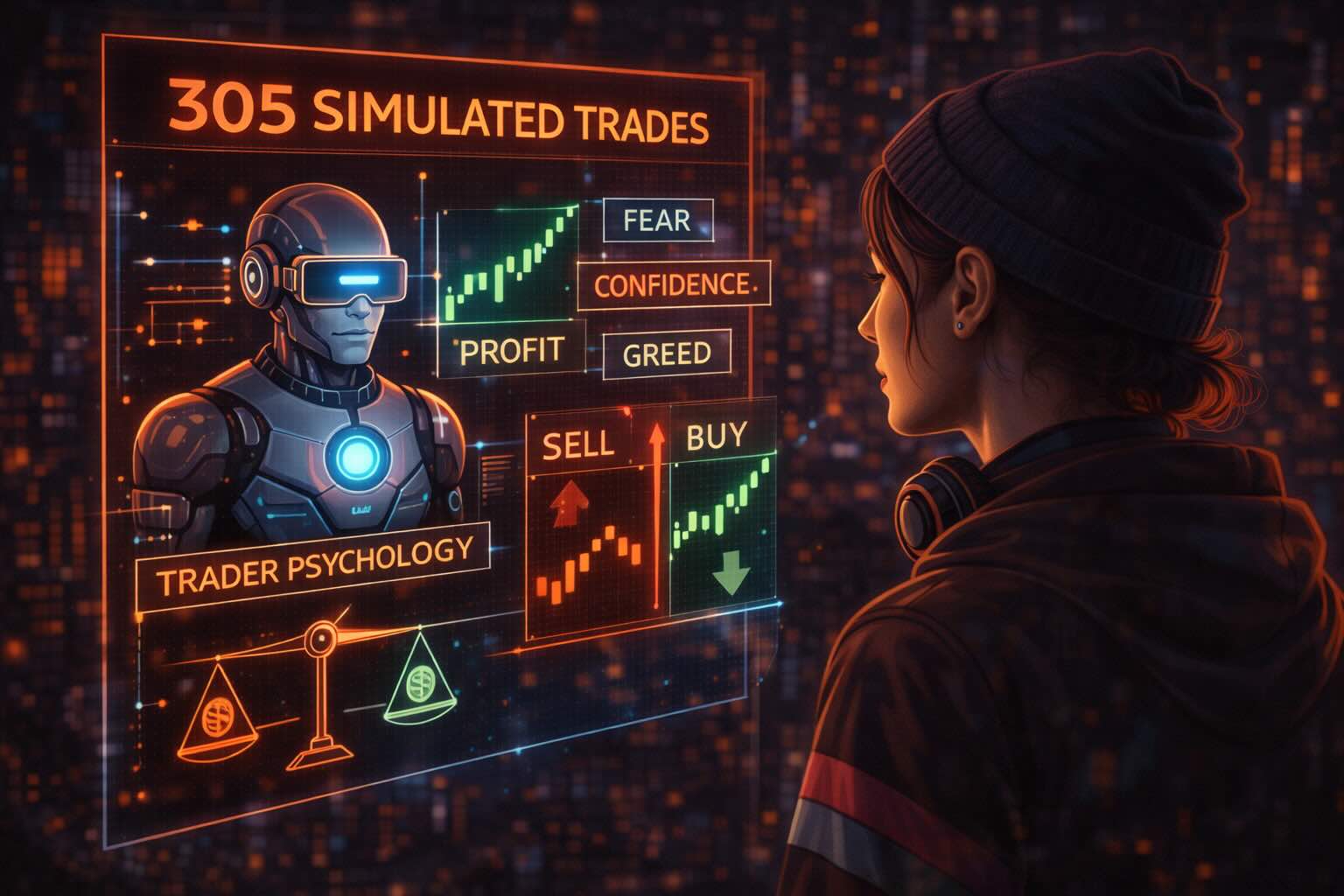
Trading Psychology is what happens to all nine of the above the second money and emotion walk in. It is the dimension that can borrow the calm of a good process and spend it on a bad trade. A single loss quietly rewrites the purpose of the next one, and the loss lands about twice as hard as the equal win would have. You do not experience this as a dimension. You experience it as certainty. That is what makes it the hardest of the ten to see in yourself, and the reason the revenge-trading loop feels like conviction from the inside.
Laid side by side, the ten stop being a list and start being a map. This is the view Ava works from: all ten at once, because a leak needs a neighbor before it shows. Each row is one axis, and the final column is the failure that only surfaces when you read that axis by itself:
| Dimension | What it reads from your history | The leak it hides on its own |
|---|---|---|
| Trade Frequency | How often you enter | Activity mistaken for progress |
| Time Horizon | How long you hold | Winners cut early, losers held late |
| Asset Spread | How many markets you run | Breadth that is really unfocus |
| Execution Complexity | How involved each trade is | Complication mistaken for edge |
| Risk Tolerance | How much you stake per position | Capped winners, or one day that erases a month |
| Risk-Reward Mastery | Size of wins against size of losses | A 40% win rate that quietly bleeds |
| Profitability | Whether the whole system nets out | A green streak on a losing method |
| Consistency | Repeatable process against lucky outliers | One outlier read as skill |
| Foundation | Understanding against imitation | Skill you cannot explain, luck not yet lost |
| Trading Psychology | What money and emotion do to the other nine | Certainty that is really tilt |
Every leak in that last column needs a second dimension standing next to it before it becomes visible. That is precisely the view you cannot assemble while a candle is moving against you, and precisely the view the read exists to produce.
Because the dimensions are not a checklist you clear one by one. They pull on each other, and your edge and your leak almost always live in the space between two of them, never tidily inside one.
Tight risk control looks like a strength on its own axis. Set it against Risk-Reward Mastery, and the same discipline that keeps your losers small is quietly cutting every winner off at the knees. Your worst habit is wearing your best one as a disguise. High conviction reads as a virtue until you set it against Time Horizon, where it becomes holding a broken thesis three weeks past the point the chart told you to leave. The strength and the leak are the same trait, read on two different axes. Ava's name for this is the reason self-diagnosis fails: you audit the dimension that hurts, not the one that is bleeding, because pain and cause sit on different lines.
It is why working the number you can see so rarely moves the account. You tighten your stops because the losses are what sting, your win rate ticks up, and your profitability quietly drops, because the leak was never in the losses. It was in the winners you were cutting to feel safe. You could not see that from inside any single trade. Each exit was reasonable on its own. The pattern only exists across all of them, which is exactly the vantage point you do not have while you are trading.
You cannot hold ten axes in your head while the market moves against a live position, and you are not meant to. The read happens afterward, across the whole set. That is the job of Pattern Intelligence. It scores all ten dimensions from your simulated history, names the archetype that behavior adds up to, and surfaces the tells that travel with it, instead of handing you one figure to be proud of.
An archetype is not a personality you chose off a quiz. It is the shape ten dimensions make once you stop reading them one at a time. Ava reads that name as a pointer, not a portrait. The value of it is not the label. It is that the label points straight at the specific gap you have been unable to see on your own, the single dimension quietly holding the other nine down. The account rarely breaks on a bad prediction. It breaks on a process leak you repeat a hundred times, because nothing on the screen ever isolated it long enough for you to notice.
Not the one that hurts. The one you have never measured.
The reason self-improvement stalls here is almost mechanical. You work the dimension you can see, because seeing it is what makes it feel like the problem, and the leak sits in the one you have never had a number for. You can stare at your win rate for a year. It will never once tell you that your Time Horizon is the reason it is not paying you, because it does not know Time Horizon exists. The number cannot report on a dimension it was never built to hold.
So the first move is not to fix anything. It is to see all ten at once, laid against each other, so the gap finally has somewhere to appear. A good trader is not the one carrying the highest single number. It is the one who found the leak before the market found it for them.
You have read what the ten dimensions are. You have never seen your own. The Trading DNA read maps all ten from your history and names the archetype they add up to in about two minutes, no signup, and it tends to point straight at a dimension you were not the one watching. Take that read into the $5,000 paper account and watch the gap it found show up in a live position.