























































































Verified Platforms
Quick Links
Where to Stay Secure
Thank you! Your submission has been received!
Oops! Something went wrong while submitting the form.


At 7:12 a.m., the buy button works perfectly.
That is the problem.
Brazil made digital money easy before it made crypto understandable. The payment rails are there. The smartphone is there. The exchange account is there. The friction that used to block entry is gone. What remains is the harder layer: knowing what you are holding, what can go wrong, and how fast confusion turns into losses once real money is involved.
This article examines Brazil's crypto education gap through the people living inside it. It is not about whether Brazil has adopted crypto. That answer is already visible. It is about why adoption without education creates a weaker market than the headline suggests.
At a kitchen table in Recife, a new holder moves from a WhatsApp tip to an exchange deposit in less time than it takes to finish a coffee. PIX does what it was built to do: move money instantly, remove delay, make digital finance feel normal. The account is funded. The chart is open. Nothing in that flow teaches custody, position sizing, scam detection, stablecoin risk, or the difference between buying a coin and understanding a market.
That gap now defines the next phase of Brazilian adoption.
Brazil is already one of the world's largest crypto markets. A March 2025 national survey reported that 25 million Brazilians — 16% of adults — own crypto. At the same time, PIX reached mass penetration at a level few payment systems ever do. By early 2025, the system counted more than 177 million users, and banking access in Brazil is broad enough that the old excuse no longer works: crypto is not waiting for better rails.
The rails arrived first.
The learning layer did not.
There was a time when crypto adoption and crypto education looked like the same problem. If someone could not get money onto an exchange, then teaching market structure felt secondary. Brazil moved past that phase unusually fast. PIX compressed the time between intention and execution. Funding an account became normal consumer behavior rather than a technical ritual.
That changes the shape of the risk.
When access is hard, the bottleneck sits at the door. When access is easy, the bottleneck moves into decision-making. The market stops filtering for patience or technical curiosity. It starts admitting anyone with a phone, a bank account, and a reason to buy.
That is not bad on its own. It is what open financial infrastructure is supposed to do. But it means the risk shifts downstream.
A person entering crypto through a clean deposit flow still has to make sense of four separate systems at once:
| Layer | What feels simple | What actually requires education |
|---|---|---|
| Funding | Send BRL with PIX | Understanding which platform is trustworthy and what fees hide in the spread |
| Buying | Click buy on Bitcoin or a stablecoin | Knowing whether the asset matches the reason for buying it |
| Holding | Leave funds where they landed | Understanding custody, counterparty risk, and withdrawal habits |
| Trading | Follow a chart or social signal | Reading volatility, sizing risk, and avoiding impulsive entries |
The interface compresses all four into one motion. The user still has to separate them.
That is where education becomes infrastructure rather than content. It is not a nice extra after the account is open. It is the difference between access creating agency and access creating exposure.
The first cost is obvious: people lose money in avoidable ways.
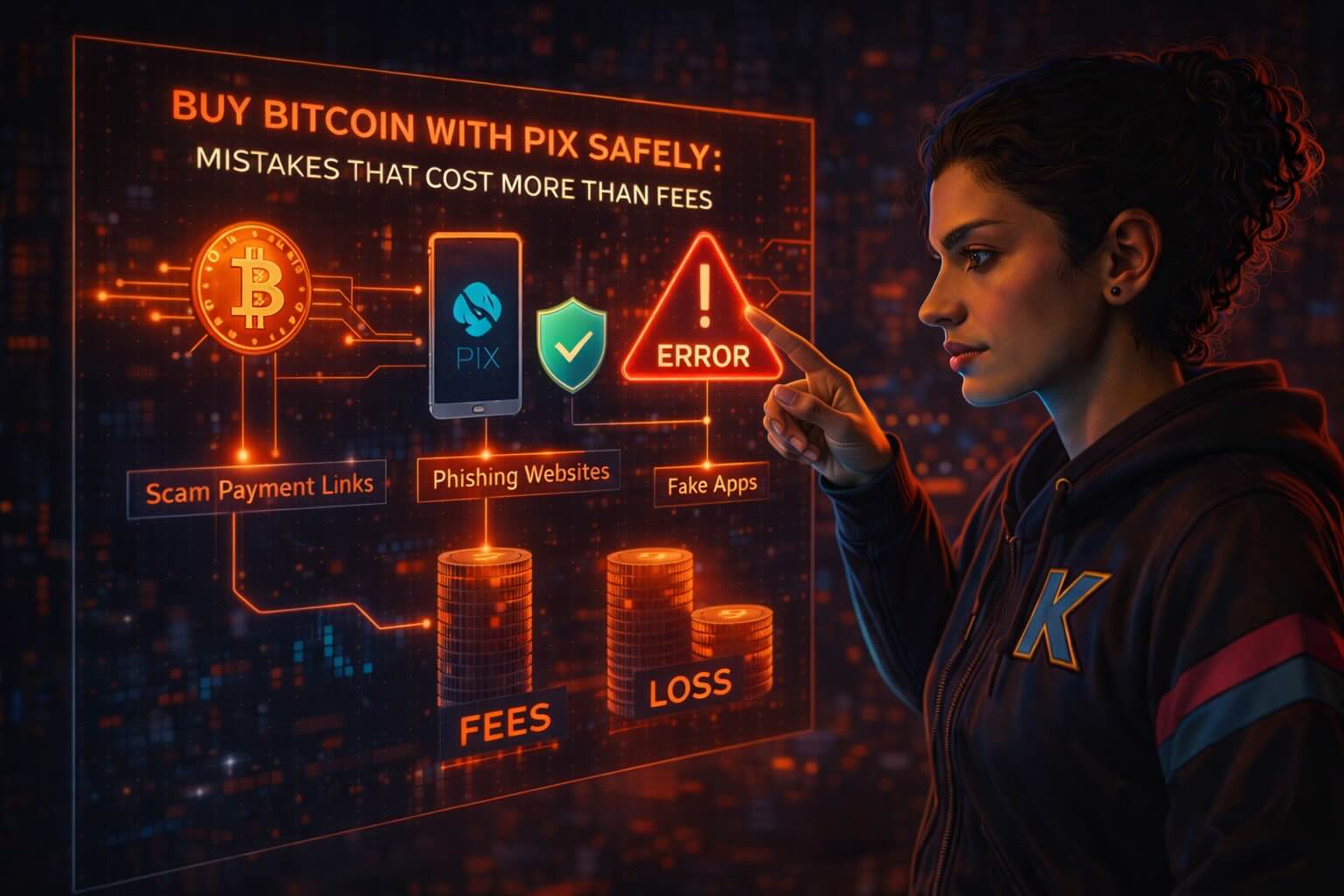
Some losses come from scams, fake support chats, cloned apps, and social engineering. Some come from buying into momentum they do not understand. Some come from confusing stablecoins with bank deposits, confusing leverage with opportunity, or confusing a green candle with a thesis. The mechanisms differ. The underlying problem is the same. People can act before they can evaluate.
The second cost is quieter. Bad first experiences narrow the market's future. A holder who gets burned early does not only lose capital. They lose trust, attention, and the willingness to keep learning. That matters in a country trying to move from speculative participation to durable financial literacy.
In early Kodex platform data, the learning problem looks sharper than the industry pitch suggests. Quiz pass rate sits at 22%, which means even people actively trying to learn struggle to convert exposure into understanding. On the simulator side, 73% of beginner losses happen in the first 48 hours. That is not a claim about all of Brazil. It is a small but useful signal about what early confusion looks like when decisions can actually be observed. The first damage usually appears before a habit exists.
That timing matters.
The common public framing treats education as a long-range fix. Learn gradually. Improve over time. Study before the next cycle. In practice, the danger window opens almost immediately. If someone funds an account today and starts pressing buttons tonight, the first two days matter more than the twentieth article they might read next month.
Education has to arrive before confidence hardens.
In January 2026, Laguna, in Santa Catarina, became the first Brazilian city to place crypto into the municipal school discussion for students in the 6th to 9th grades. The move matters for more than novelty.
It shifts crypto education out of the usual places where the topic gets trapped.
Exchanges teach enough to onboard. Influencers teach enough to attract attention. News coverage teaches enough to produce a headline. None of those environments are designed to build judgment from the ground up. A school experiment, even a limited one, treats the subject differently. It frames crypto as a social, financial, and technological system that can be examined before it is bought.
That is a better order.
The point is not that every teenager should become a crypto participant. The point is that a society with millions of holders eventually has to decide whether digital asset literacy belongs in education at all. Laguna answered yes, at least in pilot form.
What makes the move interesting is not only the curriculum. It is the admission hidden inside it: adoption came first, and public learning institutions are now trying to catch up after the fact.
That sequence tells you a lot about Brazil's market phase. The country is no longer asking whether crypto is real enough to deserve educational attention. It is asking how far behind public understanding already is.
School pilots are one piece. They are not the whole response.
Across Brazil, the education stack is starting to spread across universities, public events, private initiatives, and platform-native learning tools. That matters because no single format solves the whole problem.
In 2024, Fundação Getulio Vargas opened applications for its fifth Cryptocurrency Datathon, drawing university students into structured work around digital assets and data. In 2025, Blockchain on the Road scheduled events at universities including UFSC, UNIOESTE, UFPE, UFES, USP, and FGV, turning crypto education into something closer to a national roadshow than a niche meetup. The model is not identical to school curriculum. It sits later in the education funnel. But it reveals the same pressure: interest is ahead of structured understanding.
There is also a newer category emerging between public education and exchange marketing: incentive-based learning. Some programs borrow the language of "learn to earn" and try to create attention through rewards. That can work as an entry tool, but it creates its own tension. If the reward becomes the reason to participate, the learning layer risks collapsing back into acquisition strategy.
The formats are different because the problem has multiple depths:
| Format | What it does well | Where it falls short |
|---|---|---|
| School curriculum | Builds vocabulary early and lowers future confusion | Slow to roll out and politically uneven |
| University programs and meetups | Gives structure, peer learning, and institutional legitimacy | Reaches a narrower slice of the population |
| Exchange education hubs | Makes onboarding easy and explains product basics | Often stops where critical judgment should begin |
| Incentive-based courses | Creates attention fast | Can attract reward-seeking without building durable understanding |
| Simulators and guided practice | Lets people make mistakes without financial damage | Only works if users stay long enough to learn from the feedback |
The right question is not which model wins. It is which combination can meet a country where adoption is already mass-market.
A chart does not care whether you are learning.
That is why simulation matters more than motivational content at the first stage. The early learner does not just need definitions. They need a place where bad timing, oversized entries, panic exits, and false confidence can surface without immediate financial punishment.
That is the practical gap a simulator fills. It slows down a process that the market itself is designed to speed up.
A free account is still a step, but it is a better step than moving straight from a social signal to real exposure. That is exactly the gap Kodex Academy is built to address. The point of the Free Crypto Trading Simulator is not to make trading feel like a game. It is to let behavior reveal itself before money gets attached to it. A rushed entry looks different when you can review it. A revenge trade looks different when there is no story available about "getting it back" with the next position.
That is where education stops being abstract.
The same applies to sequence. Someone new to the space does not need every concept at once. They need the right concept before the next mistake. That is why Kodex Academy is structured as guided progression rather than pure information drop. How to Get Started With Web3 works at the front of that process because it reduces the first layer of confusion. Trading Discipline – Why Most Fail matters later because the technical mistake is often only the visible part of an emotional loop.
Good education does not only explain the market. It catches the order in which misunderstandings appear.
This is the distinction the adoption headlines blur.
Brazil is already strong on connectivity, payment infrastructure, and digital-finance habit formation. The country has the rails, the user behavior, and the market curiosity. It even has one of the clearest on-ramps in the world for moving local currency into digital systems.
What it does not yet have at matching scale is a mature civic layer of crypto understanding.
That civic layer is wider than trading education. It includes questions like:
Without that layer, mass adoption can produce a population of holders without producing a population that can read the market.
That is a weaker outcome than the adoption headlines suggest.
There is a narrow version of this argument and a wider one.
The narrow version says education reduces mistakes. True, but incomplete.
The wider version is that education changes the quality of participation inside a market. A country with millions of holders but thin understanding becomes easier to manipulate, easier to mislead, and easier to pull through repeated hype cycles. A country with stronger educational depth does not eliminate speculation, fraud, or impulse. It does create more resistance against them.
That is why this is no longer just a content problem or a customer-acquisition problem. It is a market-quality problem.
The exchanges will keep improving access. The payment rails will keep compressing friction. The headlines will keep counting adoption. None of that answers whether the next wave of participants knows how to survive contact with a volatile market.
Laguna's curriculum experiment matters because it treats the issue upstream. University events matter because they create structure around curiosity. Simulators matter because they create feedback before financial damage. Kodex Academy belongs in that last category: not as a replacement for public education, but as part of the practical layer that helps close the gap before the first real loss. Taken together, these are signs that Brazil is starting to build the missing layer after the adoption wave already arrived.
Late is still better than absent.
The next edge in Brazil is not making crypto easier to reach.
That part is already here.
The edge is teaching people to distinguish between access, ownership, speculation, and understanding before those collapse into one click. The market has enough on-ramps. It needs more filters, more sequence, and more environments where a mistake becomes a lesson instead of a bill.
That is the real meaning of crypto education in Brazil now: not more content for its own sake, not louder onboarding, but a stronger layer between permission and action.
A country can lead in adoption and still lose on understanding.
If understanding keeps lagging, the market does not just stay immature. It stays expensive for the people entering it last.
This article's danger window is the first 48 hours, so spend yours where they cannot bill you. Open the Kodex simulator and run the exact sequence it describes: a signal, a funded account, a buy pressed before the thinking arrives. The impulse is real, the rushed entry and the panic exit are real, and none of it reaches your bank. Review what your first two days reveal before a real deposit makes them expensive.