































































































Verified Platforms
Quick Links
Where to Stay Secure
Thank you! Your submission has been received!
Oops! Something went wrong while submitting the form.

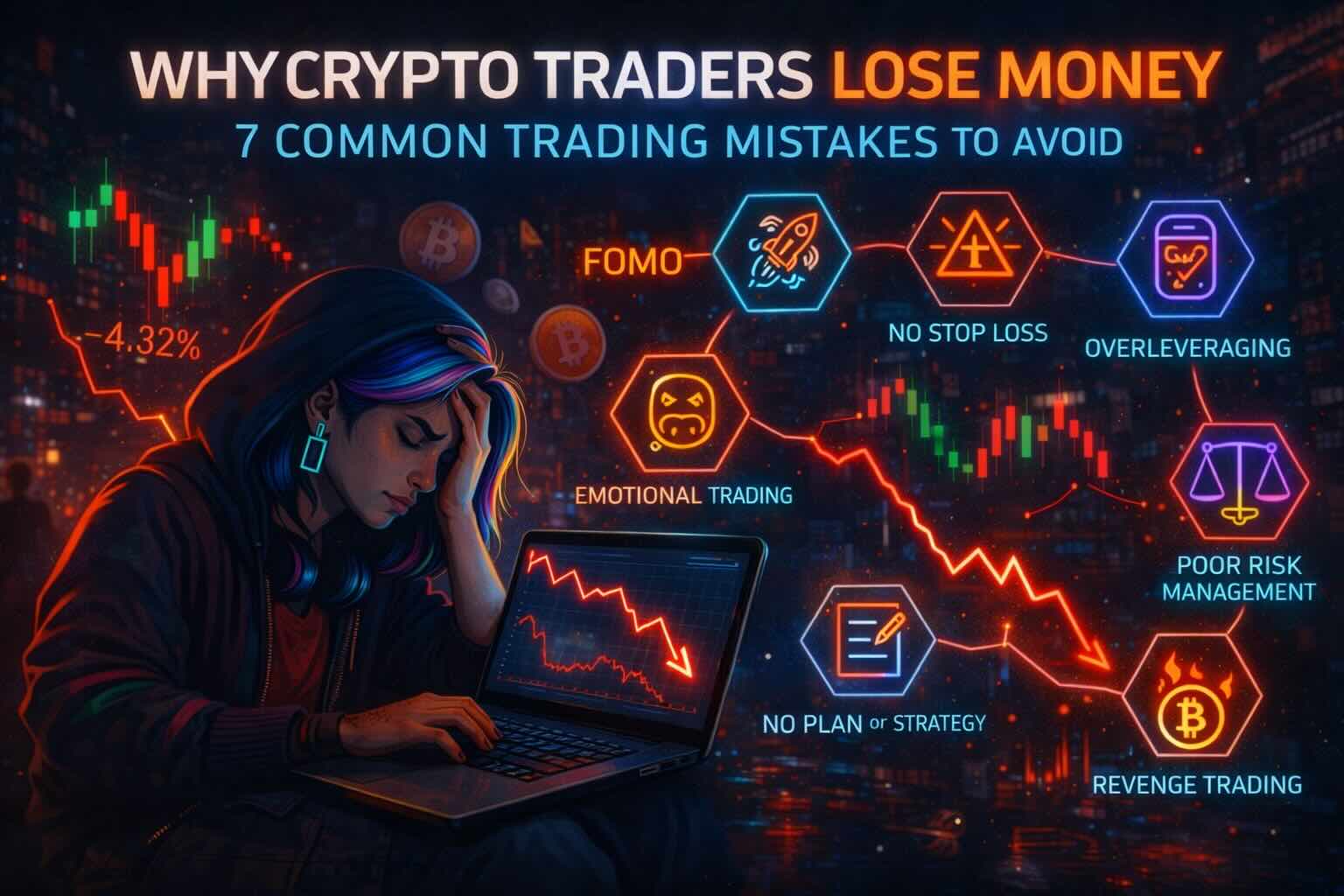
You usually do not lose because you cannot read a chart. You lose because your process breaks before your idea does.
That is why your most expensive trading mistakes are usually not prediction mistakes, but process mistakes.
The market does not need to be against you for your account to bleed capital. In crypto, small structural mistakes do the job just fine: oversized positions, sloppy entries, ignored fees, a stop moved one more time because the candle "looks like it will come back."
Trading mistakes are often described as emotional failures. That is only half true. Emotion matters, but the deeper issue is structural: you are making decisions in a market that trades 24/7, reprices fast, and punishes weak sizing, weak execution, and weak context. The expensive part is not one bad call. The expensive part is repeating a bad process.
A lot of beginner guides stop at generic warnings: avoid FOMO, use stop-losses, do research. Fair enough. But that framing stays too shallow. The useful question is different: what mechanism turns a manageable mistake into a compounding loss? Once you understand that mechanism, you stop treating discipline like a personality trait and start treating it like infrastructure.
Crypto compresses feedback loops. The market is open around the clock, liquidity shifts across sessions, and derivatives can amplify even a small pricing mistake. A weak trade idea in a slow market might cost you a little. A weak trade idea in crypto can combine with slippage, leverage, liquidation pressure, and panic execution in a matter of minutes.
The same seven errors keep showing up because the underlying pattern is the same: people enter crypto treating volatility as opportunity before they learn how volatility taxes bad decisions.
Here is the key shift: a mistake in crypto is not just a wrong opinion about price. It is usually one of three failures:
That is the lens for the rest of this article. Each of the seven mistakes below leaks capital through one of those three failures.
| Mistake | What it looks like in real time | Why it gets expensive |
|---|---|---|
| Trading without a defined setup | Entering because price feels active | You cannot measure edge if the entry rule keeps changing |
| Oversizing positions | One trade is large enough to alter your mood | Normal volatility becomes existential |
| Using leverage as a shortcut | 10x to make a small account feel meaningful | Small errors get magnified into forced exits |
| Moving or skipping the stop | "I'll give it more room" | You convert a planned loss into an uncontrolled one |
| Trading without market structure | Buying one candle without market structure | You confuse motion with opportunity |
| Revenge trading after a loss | Immediate re-entry to make money back | Emotional urgency destroys selectivity |
| Ignoring trading friction | Fees, spread, slippage, funding left out | Weak trades become negative even when direction was almost right |
A surprising number of trading mistakes happen before your capital touches the market. The trade exists because the chart feels interesting, someone on social media sounds confident, or price has already moved enough to create urgency. None of that is a setup.
A setup is a checklist, not a vibe. What market structure is in play? What invalidates the trade? What confirms momentum? What makes this entry different from random participation? If you cannot answer those questions in one sentence each, the trade is still forming in your head, not on the chart.
That is also why "doing research" is too vague to be useful on its own. Research only helps if it sharpens the setup rather than giving you more reasons to improvise.
This is where tools like RSI and Bollinger Bands can help — but only if they are used as context tools rather than as signal buttons. RSI can show momentum exhaustion or confirmation. Bollinger Bands can show expansion and compression. Neither can rescue an undefined idea.
The blind spot is thinking bad outcomes come from bad indicators. Usually they come from bad premises. An indicator layered onto a vague thesis just makes the vagueness look more professional.
This is the quiet account killer. You will often try to solve a process problem with a size solution long before you recognize that as the mistake. The logic goes like this: if the account is small, the trade needs to be bigger to matter. That logic is how volatility starts making decisions for you.
Position size is a survival variable first, a return variable second. If one candle can push you into panic, the size is wrong even if the trade idea was fine. You are no longer managing a setup. You are managing your nervous system.
That is why oversizing usually shows up before you notice it as a mistake. It first appears as urgency, attachment, and the need for the trade to work.
That is why risk-to-reward is not a decorative concept. A risk-reward ratio only means something if your loss is actually tolerable and pre-accepted. When size is too large, you start editing the plan mid-trade. Stops widen. Targets shrink. Time horizons mutate. The structure collapses.
Leverage is not evil. It is precision equipment. The problem is that you will often use it as compensation for an account size or time horizon you do not want to accept.
If your trade only feels worthwhile at 20x, that is usually a clue that the setup is too weak, the account is too small for your expectations, or both. Leverage compresses the distance between ordinary market noise and forced exit. In crypto, where intraday price swings can be violent without changing the larger structure, that compression matters.
Leverage is a fragility multiplier. Used carefully, it can improve capital efficiency. Used to chase significance, it turns tiny execution errors into liquidation problems.
The psychological trap is that leverage can make a weak setup feel serious. The position feels more meaningful, but the edge underneath it has not improved.
The moment leverage becomes high enough that liquidation sits inside normal volatility, the trade is no longer really about the thesis. It is about whether the market breathes against you before it moves your way. That is not edge. That is timing roulette with better typography.
One of the oldest trading mistakes is also one of the easiest to rationalize. The stop was there. Price moved toward it. Then the explanation changed.
Sometimes that rewrite will save the trade. That is exactly why it is dangerous. The occasional rescue teaches the wrong lesson. It trains you to believe discretion is superior to process, when what actually happened is that variance bailed you out.
The rule is blunt: if the invalidation was real enough to size the trade around, it is real enough to respect after entry. If the stop placement was wrong, fix the method in the journal, not inside a live position.
This is why bad stop discipline compounds so fast. Once the stop becomes negotiable, the trade stops being structured risk and starts becoming open-ended hope.
A lot of articles mention FOMO, but the deeper issue for you is usually context collapse. You see movement and assume significance. You see one breakout candle and ignore liquidity above. You see a reclaim and ignore that the broader range is still intact.
Crypto is especially good at manufacturing false urgency. The market is fast, social feeds amplify every move, and perpetual futures make short-term action feel meaningful even when it is just rotation inside a broader structure.
The better sequence is simple: higher timeframe first. Key levels second. Liquidity and participation third. Entry trigger last. If the sequence is reversed, you start from excitement and backfill logic afterward.
Because action feels like progress. Watching a market move without taking part can feel like falling behind. But movement alone does not create a trade. It only creates stimulation.
This is where a journal matters more than another indicator. When you log why a trade existed, what condition you were trading, and what would have invalidated the idea before entry, patterns appear quickly. The useful lesson is usually not that you lacked information, but that you acted on a signal without enough structure around it.
More information does not fix impulsive participation. Better sequencing does.
That is the real difference between analysis and stimulation. Analysis narrows the trade. Stimulation just makes it feel harder to sit still.
Revenge trading gets described as an emotional mistake, which it is, but the structural mechanism is what matters: the first loss changes the purpose of the next trade. Instead of asking whether the setup is good, you ask whether the setup can repair damage.
That shift is lethal.
The setup may look similar on the surface, but the function of the trade has already changed. It is no longer about edge. It is about repair.
The clearest warning sign is urgency. If the next trade feels necessary, it is probably contaminated. A valid setup can survive being skipped. A revenge setup feels like it cannot wait.
The practical fix is boring and effective. After a meaningful loss, force a break measured by time, not mood. Ten minutes. Thirty minutes. End of session. Whatever rule you choose, choose it before the loss happens. Recovery rules only work when they are defined in advance.
This is also where overtrading usually enters. You are no longer reacting to the market alone, but to the emotional residue of the previous position.
This is one of the most underestimated process leaks in crypto trading. Plenty of guides warn you about emotion and leverage. Fewer explain how trading friction quietly destroys mediocre strategies.
If your entries are late, your exits are reactive, and your trade frequency is high, the market does not need to move far against you for the account to deteriorate. Fees stack. Spread matters more in thinner books. Slippage grows when you chase momentum. Funding changes the economics of holding derivatives over time.
This is why mediocre strategies often look better in hindsight than they perform in reality. The direction was close enough, but the friction was real enough to erase the trade.
Friction is like gravity. It is always there whether you model it or not. A strategy that only works before costs is not a strategy. It is a backtest fantasy wearing a market order.
Instead of memorizing motivational rules, use a compact pre-trade filter:
| Question | If the answer is weak | What to do |
|---|---|---|
| What is the setup? | You cannot describe it clearly | No trade |
| Where is invalidation? | It keeps moving in your head | Rebuild the idea |
| What size keeps this emotionally neutral? | The trade feels too important | Reduce size |
| What market condition am I trading? | You only see one candle | Zoom out |
| What costs are attached to this trade? | You have not checked fees or spread | Recalculate |
| What happens after a stop-out? | No rule exists | Define pause conditions |
This is not glamorous. That is the point. Good process often feels underwhelming compared with prediction culture. But survival in crypto is usually built from anti-drama, not brilliance.
Most losing trades do not begin as disasters. They begin as ordinary decisions made without enough structure around them.
Underneath the list, one pattern keeps returning: you start treating trading as a way to prove something quickly instead of as a system to execute repeatedly.
That is the blind spot. You think the account is losing because your market calls are not sharp enough. Often the real issue is that your operating process cannot absorb normal volatility without breaking. You do not need a more heroic strategy. You need one that remains intact after being wrong.
The market does not need you to be dramatically wrong. It only needs you to be structurally fragile.
The clean answer is not to eliminate mistakes. You will not. The goal is to make crypto trading mistakes smaller, less emotional, and less structurally expensive.
The framework is simple:
None of those rules are designed to make trading feel exciting. They are designed to keep one mistake from mutating into five. They are designed to keep you solvent long enough to improve.
That does not make trading easy. It makes your decisions legible. And once your decisions are legible, improvement stops being motivational and starts becoming mechanical.
If you remember one thing, let it be this: your trading mistakes are rarely random. They are usually process leaks. Find the leak before you earn the right to take the next trade.
Take one crypto setup into the simulator and run it twice: once sized so a single candle can move your mood, once sized so it cannot. Fix the invalidation before you enter, refuse to touch it, then read the journal to see whether the loss was the plan or an improvisation you made under pressure. No capital moves either way, so the only thing you find out is how your own process holds up when the candle turns against you.