

























































































Verified Platforms
Quick Links
Where to Stay Secure
Thank you! Your submission has been received!
Oops! Something went wrong while submitting the form.

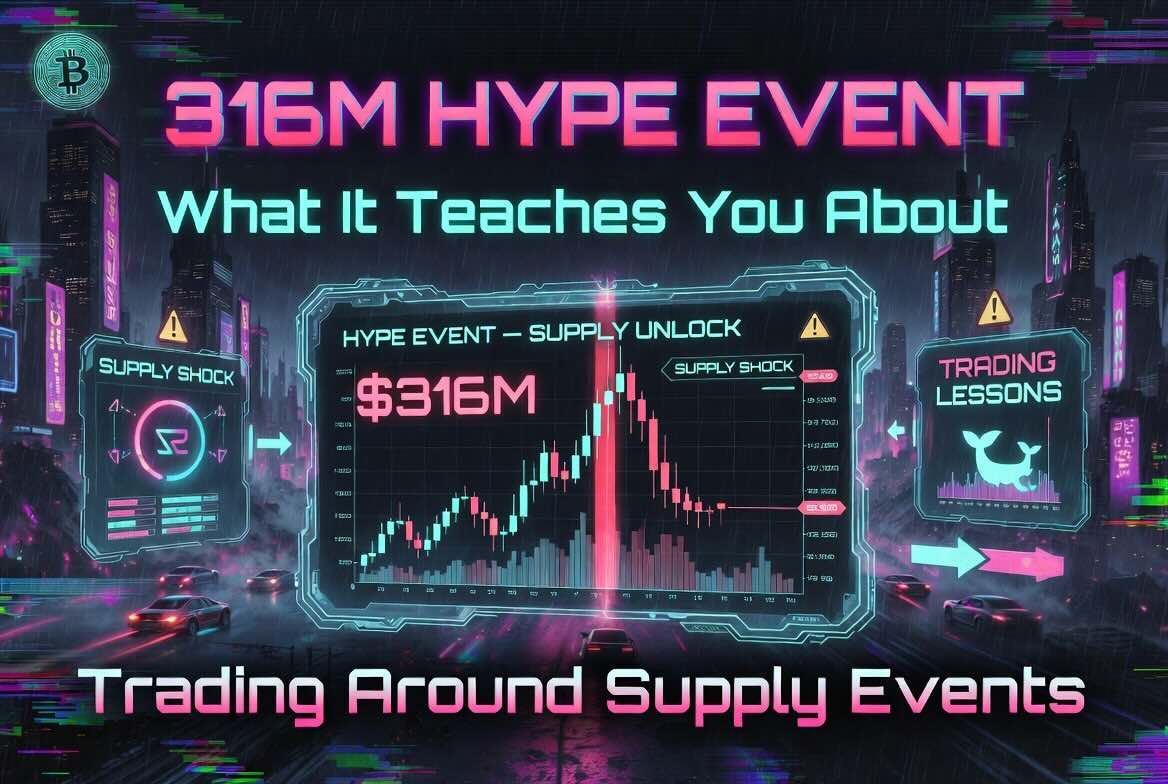
By the end of this piece, you should understand what a token unlock actually is, why the recipient often matters more than the headline size, how to read the pre-event window, and why the HYPE unlock on March 6 is a useful case study for building this into your analysis — whatever you are holding. Tokenomist tracked the HYPE unlock as 9.92 million tokens released to Core Contributors, and multiple market summaries put the event at roughly $305–$317 million, depending on the token price snapshot used.
Let’s begin.
Ava — one of the analysts inside the Kodex system, known for dissecting the structural mechanics most traders overlook — does not open with the calendar.
She opens with a question.
“Before you enter any position, what do you check?”
You go through the usual list: chart structure, volume, RSI, maybe funding if it is a perpetuals market. Macro if you are paying attention.
“Good,” she says. “Now: did you check the unlock schedule?”
That question matters more than it sounds.
Positions taken without that check are often positions taken blind on one of the most visible and most consistently ignored sources of supply pressure in crypto. Keyrock’s study of more than 16,000 token unlock events found that roughly 90% were associated with negative price pressure, and that the market often started adjusting up to 30 days before the unlock date itself.
Every crypto project launches with a token supply structure. Some portion is available early to the market. Some portion is allocated to founders, investors, contributors, foundations, or ecosystem programs and then released over time according to a vesting schedule.
A token unlock is the scheduled release of some of those previously restricted tokens into transferable circulation.
That does not automatically mean the tokens will be sold. It means they can be sold.
That distinction matters.
The lock exists to avoid the obvious failure mode: if insiders received everything at launch and could immediately exit, price discovery would collapse into a race for the door before the project had time to build anything. Vesting is meant to align incentives across time. In practice, it also creates one of the few areas in crypto where a meaningful part of future supply is visible in advance. The date is known. The amount is known. The recipient category is usually known. That makes the event analyzable before it arrives.
Ava is calm about it.
“The unlock calendar doesn’t tell you the outcome,” she says. “It tells you where the pressure is likely to come from. The rest is how the market absorbs it.”
That is the right way to read it.
The data matters here because unlocks are often treated too casually — either as automatic disaster or as irrelevant because “the market already knows.”
The better answer is more specific.
Keyrock’s research found that around 90% of unlocks were associated with negative price pressure, that the impact often began about 30 days before the event, and that larger unlocks tended to produce more severe effects — roughly 2.4 times the impact of smaller ones. More importantly, the recipient class mattered: team unlocks were the worst-performing category, while ecosystem-related unlocks tended to produce the weakest negative reaction.
That is the part traders tend to miss.
The market does not just react to “more supply.” It reacts to what kind of holder is receiving that supply, how likely they are to distribute it, and whether other participants expect that distribution in advance.
So yes, size matters.
But size without recipient context is a blunt instrument.
Now bring that framework to HYPE.
Tokenomist tracked the March 6, 2026 unlock as 9.92 million HYPE released to Core Contributors. Depending on the price snapshot used, market summaries put the unlock value at roughly $305 million to $317 million. That places it squarely in the category of events the market has reason to care about before the day arrives.
That is the baseline read.
A contributor unlock is not the same thing as an ecosystem grant release. It sits closer to the category the market has historically treated with more caution. If you were reading only the unlock schedule and nothing else, that would already be enough to mark the event as relevant.
But HYPE is not a clean textbook example of a simple supply dump.
That is where the case study becomes more interesting.
Reports around the event pointed to strong fee-driven token burn activity on Hyperliquid. Tokenomist’s burn dashboard showed HYPE among the largest recent burn programs, and market coverage around the unlock focused on the idea that rising protocol revenue and buyback-related burns were offsetting part of the new supply entering circulation.
There is also a second layer.
In December 2025, Hyperliquid governance moved to treat the Assistance Fund HYPE as permanently burned, with multiple reports describing roughly 37–37.5 million HYPE as effectively removed from supply after validator approval. That did not mean those tokens were newly bought back from the market. It meant a previously existing reserve was formally treated as irretrievable and excluded.
That changes the texture of the event.
Not because it guarantees upside.
Not because it cancels the unlock.
Not because burn automatically beats distribution.
It changes the texture because the supply story is no longer one-dimensional.
Ava looks at the screen for a second before speaking.
“This is the mistake traders make with unlocks,” she says. “They see new supply and stop reading. But what matters is net pressure — not just issuance, but what is being removed, who is receiving, and what the market has already priced before the date arrives.”
That is the better read.
The HYPE event is not interesting because it tells you what to do. It is interesting because it forces you to read both sides of the supply equation at once.
Ava pulls up the position you are considering.
“Before size and entry,” she says, “three checks.”
First: is there an unlock in the next 30 days?
Not just for the token you are trading. For correlated names in the same sector too. The market does not always isolate supply pressure cleanly. A large unlock in one closely watched protocol can affect the way the whole category trades around that window. Keyrock’s data matters here precisely because the pressure often starts before the event date.
Second: who receives the unlocked tokens?
This is where the chart calendar becomes market structure rather than trivia. Team or contributor unlocks deserve more caution because history says they tend to produce worse price behaviour than ecosystem or community allocations. That does not mean a crash is guaranteed. It means the burden of proof is different.
Third: is there a structural offset?
A fee-funded burn, a buyback mechanism, a locked staking sink, or some other meaningful absorption mechanism changes the read. Not by erasing risk, but by changing the net supply path the market is trying to price. HYPE is useful as a case study because it does not let you stay lazy on that question.
Run those checks first.
Then decide how much exposure the setup deserves.
Not based on prediction. Based on pressure.
The pre-unlock window often shows up in momentum and participation before it becomes obvious in narrative.
A token heading into an unlock can start weakening relative to the broader market before the event date gets attention. RSI cooling while peers hold up matters. Volume divergence in the week before the event matters. Failure to respond to broader market strength matters. Those are not separate from the unlock. They are often the market beginning to digest it.
Market Tools at Kodex runs RSI, MACD, Bollinger Bands, and eleven other indicators across live market data. That lets you read how momentum and volume are behaving around a supply event instead of guessing from the headline alone.
The crypto trading simulator is where you practice trading around supply events without putting real capital at risk. Set up a paper position on a token approaching an unlock. Watch how the pre-event window behaves. Track where you would have entered, how you would have sized, and whether you would have held into the date or reduced before it.
Pattern recognition does not come from reading one article and feeling wiser for an hour.
It comes from repetition.
The HYPE unlock is one event.
That is the point.
The value of the case study is not that HYPE is uniquely special. It is that this kind of supply event is happening constantly across crypto, and traders still routinely treat it as secondary information instead of basic market structure.
You already check the chart.
You already check volume.
You probably already check funding if derivatives are involved.
Adding the unlock calendar to that sequence takes almost no time and removes one of the most avoidable blind spots in the market.
Ava closes the tab.
“It’s public information,” she says. “The only question is whether you looked.”
Pick a token with an unlock inside the next 30 days and open a paper position on it in the simulator. Watch the pre-event window do its work: RSI cooling while peers hold, volume thinning before the date, price failing to answer broader strength. You choose the size, you decide whether to hold into the unlock or trim ahead of it, and you find out how your read of net supply pressure behaves against a live chart, with a balance that is simulated and habits that are not.