




























































































Verified Platforms
Quick Links
Where to Stay Secure
Thank you! Your submission has been received!
Oops! Something went wrong while submitting the form.

Every system claims neutrality.
Power is what remains once incentives settle.
One of the quiet failures of the modern internet is that it trained us to confuse access with ownership.
You had accounts. Profiles. Followers. Uploads. Dashboards. It all looked personal. It felt earned. You invested time, creativity, and attention, and in return you received visibility and reach. Over time, that visibility started to feel like possession.
But it wasn’t.
The moment you tried to leave a platform, migrate an audience, or extract value from what you had built, the illusion collapsed. Your content stayed behind. Your relationships stayed behind. Your economic value stayed locked inside systems you did not control.
Web3 begins by refusing that confusion.
Ownership in Web3 is not about expression or recognition. It is not about how something looks or feels. It is about control over state. If you can move it without permission, transfer it without approval, and exit with it intact, then you own it. If you cannot, you don’t.
◈ Ownership Check:
Ownership is the ability to leave without asking.
This distinction matters because it changes how value behaves. In Web2, value accumulates where platforms can trap it. In Web3, value is designed — at least in theory — to remain portable. That single architectural shift is the foundation for everything that follows.
Tokens are where Web3 narratives tend to break down, because they are discussed almost exclusively through price.
That framing is shallow and misleading.
A token is not a reward. It is not a badge. It is not inherently an investment. At its core, a token is a coordination mechanism — a way to align incentives among participants who do not know or trust each other.
In Web2, platforms coordinate behavior through policies, contracts, and centralized enforcement.
In Web3, coordination happens through economics encoded into systems. Tokens represent rights, responsibilities, and exposure to outcomes. They can grant access, voting power, fee participation, or the ability to influence the direction of a protocol.
The crucial difference is this: tokens embed incentives directly into infrastructure.
If you contribute to a system, you can receive a stake in its future. If you misuse it, you can lose that stake. If you govern it poorly, the value you hold reflects that failure. This feedback loop is immediate and structural, not reputational.
◈ This is why tokens are powerful— and why they are dangerous.
When designed carefully, they allow global coordination without centralized authority. When designed poorly, they incentivize extraction, speculation, and short-term behavior. The system does not care which one emerges. It simply executes the incentives it was given.
𓂀 Kodex Insight:
Tokens don’t create alignment. They reveal it.
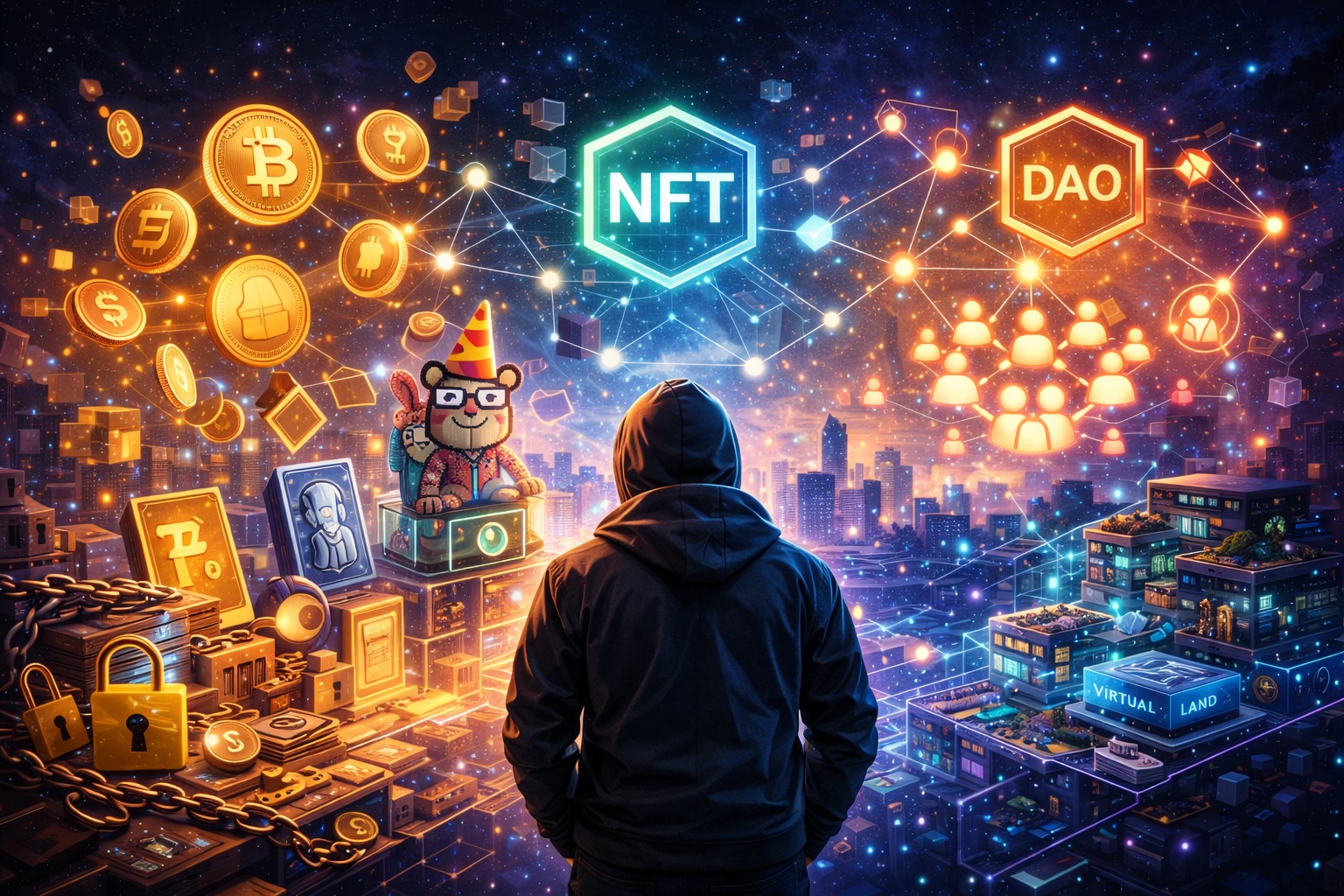
NFTs became famous for the wrong reasons.
Speculation dominated the narrative, turning a subtle idea into a caricature. But strip away the hype, and NFTs address a real structural problem the internet never solved: how to represent unique ownership in a digital environment.
Before NFTs, digital assets were either infinitely copyable or centrally controlled. You could own access to something, but not the thing itself. NFTs introduced a primitive but important concept: a unique, transferable reference to an asset, recorded on shared infrastructure rather than a private server.
This does not magically make all NFTs valuable. Most are not. But the mechanism itself is meaningful. It enables digital property that is not tied to a single platform’s database. An NFT can move between applications, markets, and contexts without being reissued or approved.
◈ The real significance of NFTs is not art. It is portability of identity and value.
They allow credentials, memberships, licenses, and creative works to exist independently of the platforms that display them. That is why NFTs keep resurfacing in domains like gaming, ticketing, identity, and media — long after speculative cycles fade.
⚠︎ Friction:
Property without standards becomes noise. Standards without restraint become extraction.
Again, the technology does not guarantee quality. It only enables new forms of ownership. What those forms become depends entirely on design and culture.
Decentralized Autonomous Organizations (DAO) promise something radical: coordination without hierarchy.
No CEOs. No boards. No centralized control. Instead, rules encoded in smart contracts and decisions made by token holders through on-chain voting.
In practice, DAOs sit in uncomfortable territory between idealism and reality.
At their best, DAOs allow global communities to pool capital, manage shared resources, and govern protocols transparently. They make funding programmable, participation visible, and decision-making auditable. For open-source infrastructure, this is a meaningful upgrade from opaque foundations and informal power structures.
At their worst, DAOs replicate the same inequalities they claim to escape.
Token-based voting often concentrates power in the hands of those with the most capital, not the most insight. Participation drops as complexity rises. Governance becomes symbolic rather than operational. A small group proposes, a smaller group votes, and the rest disengage.
◈ This does not mean DAOs have failed. It means governance is hard.
𓂀 Kodex Insight:
Decentralization removes rulers. It does not remove politics.
DAOs expose a truth most organizations hide: power always emerges where incentives allow it. The difference is that in Web3, this power is visible, measurable, and contestable. That doesn’t solve the problem — but it changes how it can be addressed.
No discussion of Web3 ownership is complete without addressing venture capital.
Early infrastructure is expensive to build. Capital accelerates development. This is not controversial. What is controversial is what happens when ownership narratives collide with capital concentration.
Many Web3 protocols launched with rhetoric about decentralization while allocating large portions of their token supply to founders, early investors, and insiders. In some cases, governance became decentralized in name only, with meaningful control resting in a small set of wallets.
This tension is real, and criticism is justified.
But the presence of capital does not automatically invalidate the model. The question is not whether VCs participate — it is whether systems are designed to dilute early power over time through usage, contribution, and open participation.
◈ Web3 does not eliminate power asymmetries. It makes them programmable.
⚠︎ Reality:
If a system cannot decentralize ownership over time, it is not unfinished. It is honest.
Some protocols succeed at this. Many do not. The difference lies in incentive design, not ideology.
Web3 does not serve everyone equally.
It favors those willing to learn, to experiment, and to accept responsibility. It rewards participation more than belief, contribution more than consumption. It is unforgiving to passivity and brutal to ignorance.
This is not elitism. It is structural reality.
Web3 removes intermediaries, and intermediaries exist for a reason: they absorb complexity. When they disappear, complexity returns to the user. Some people welcome that. Others do not.
⧉ Pause:
Do you want sovereignty — or convenience? You rarely get both.
The systems emerging now are negotiating that boundary in real time.
Ownership in Web3 is real — but conditional.
Power is redistributed — but not erased.
The architecture allows new forms of participation, but it does not guarantee fair outcomes. It simply exposes the mechanics that were always there.
Which brings us to the most practical question of all:
If this is the terrain, how do you enter it without illusions, without capital, and without losing yourself to noise?
How to Enter Web3 With $0 — and Without Illusions
The system is open.
That does not mean the path is obvious.
This lesson draws the line between access and ownership at one point: whether you can hold something, sit through its outcome, and leave with it intact without asking permission. Open a token position in the Kodex simulator and take it through a full round trip, entry to exit, so exposure to outcomes stops being a phrase and becomes a decision you actually make. The balance is fictional and no real capital moves, yet the call on when to hold and when to walk away is completely your own.