

























































































Verified Platforms
Quick Links
Where to Stay Secure
Thank you! Your submission has been received!
Oops! Something went wrong while submitting the form.


The fraud does not start where the blockchain explorer lights up first. By the time a transfer hits Bitcoin, Ethereum, or a stablecoin, the real work is often already done: trust has been manufactured, credentials have been stolen, and the victim has been guided through a system built to feel familiar.
This article tracks how ordinary payment habits get redirected into crypto rails.
The starting point is the part that usually gets skipped: the handoff between bank infrastructure, fake interfaces, and the conversion layer where stolen money becomes portable across systems.
The environment is strong for digital finance because the rails are fast, cheap, and widely used. That same strength also creates a clean attack surface. Pix made instant transfer behavior normal. Exchange access made crypto conversion and liquidation normal. Mobile-first finance made app trust normal. A scammer does not need to invent new behavior inside that environment. They only need to redirect behavior that already feels normal.
That is why the victim so often feels normal right up until the loss becomes visible.
That is the mechanism that matters here. These scams are not just wallet scams, romance scams, or phishing campaigns sitting in separate buckets. The more useful frame is a pipeline: gain trust, obtain access, move value through local payment rails, convert it into crypto, layer the funds, then cash out through whichever venue creates the least friction.
Coverage around this topic often collapses into lists of scam types or generic "stay safe" advice. That misses the structure. The structure is what lets small lies become large theft.
The incentive comes first. Criminals want speed, scale, and plausible normality. Pix gives them all three.
The real-time payment infrastructure is mainstream enough that a transfer request does not feel suspicious by default. According to BankInfoSecurity, Pix had 169 million registered members and was used by 94% of adults, with two-thirds saying it was their most frequent payment method. That matters because scams do not usually succeed by forcing victims into alien behavior. They succeed by making dangerous behavior feel routine.
Someone who would hesitate to wire money abroad may not hesitate to approve a Pix transfer that looks like account verification, fraud prevention, or a temporary security step. The trap works because the action does not feel reckless when it is happening.
Once the money is moving, crypto becomes attractive for a different reason: portability. It compresses distance. It can be layered through multiple assets and venues. It can move from local fraud into a global laundering network without waiting for the banking system to slow it down.
Crypto is rarely the persuasion layer first. It is usually the portability layer after trust has already been broken.
Chainalysis estimated that crypto scams and fraud pulled in at least $14 billion onchain in 2025, with the figure potentially exceeding $17 billion as more illicit addresses are identified. More important than the headline number is the shape beneath it: impersonation scams grew 1400% year over year, and AI-enabled scams were 4.5 times more profitable than traditional ones. Fraud is getting better at the front end, not just bigger at the back end.
The cleanest way to understand these scams is to stop asking which scam label applies and start asking where the victim is being positioned.
Here is the recurring sequence visible across the evidence.
| Stage | What the victim sees | What the operator needs | Why crypto appears later |
|---|---|---|---|
| Trust setup | Support message, romance contact, investment invitation, fake alert | Attention and compliance | No wallet needed yet |
| Access capture | Credentials, seed phrase, remote access, fake app install | Account control or payment authority | Crypto conversion comes after access |
| Local movement | Pix transfer, card use, bank withdrawal, mule routing | Speed inside domestic rails | Makes funds portable before freeze |
| Crypto conversion | OTC desk, exchange account, broker, stablecoin purchase | Cross-border or layered transfer | Breaks the local trace into global rails |
| Laundering and cash-out | Swaps, bridges, stablecoins, resale, shell entities | Distance from original theft | Obscures source and ownership |
That table matters because it prevents a common analytical mistake: treating the visible onchain transfer as the first real event. It is usually not the first event. It is the portability phase.
TRM Labs' write-up on Operation Deep Hunt showed the pattern clearly. Brazilian authorities dismantled a syndicate accused of laundering more than R$164 million through cryptocurrency after the group acquired stolen banking data, cloned cards, and forged documents. The crypto leg mattered, but it came after the data theft, after the fraudulent access, and alongside shell companies and false accounts. That case is a reminder that crypto is often the scaling layer, not the origin point.
A different 2025 case around Brazil's central bank service infrastructure pointed to the same logic from another angle. DL News reported that attackers used compromised credentials tied to C&M Software, moved an estimated 800 million reais, and laundered roughly $30 million to $40 million through Bitcoin, Ethereum, and stablecoins. Again, the mechanism was not "crypto magic." The mechanism was a breach in trust and access, followed by rapid conversion into harder-to-freeze rails.
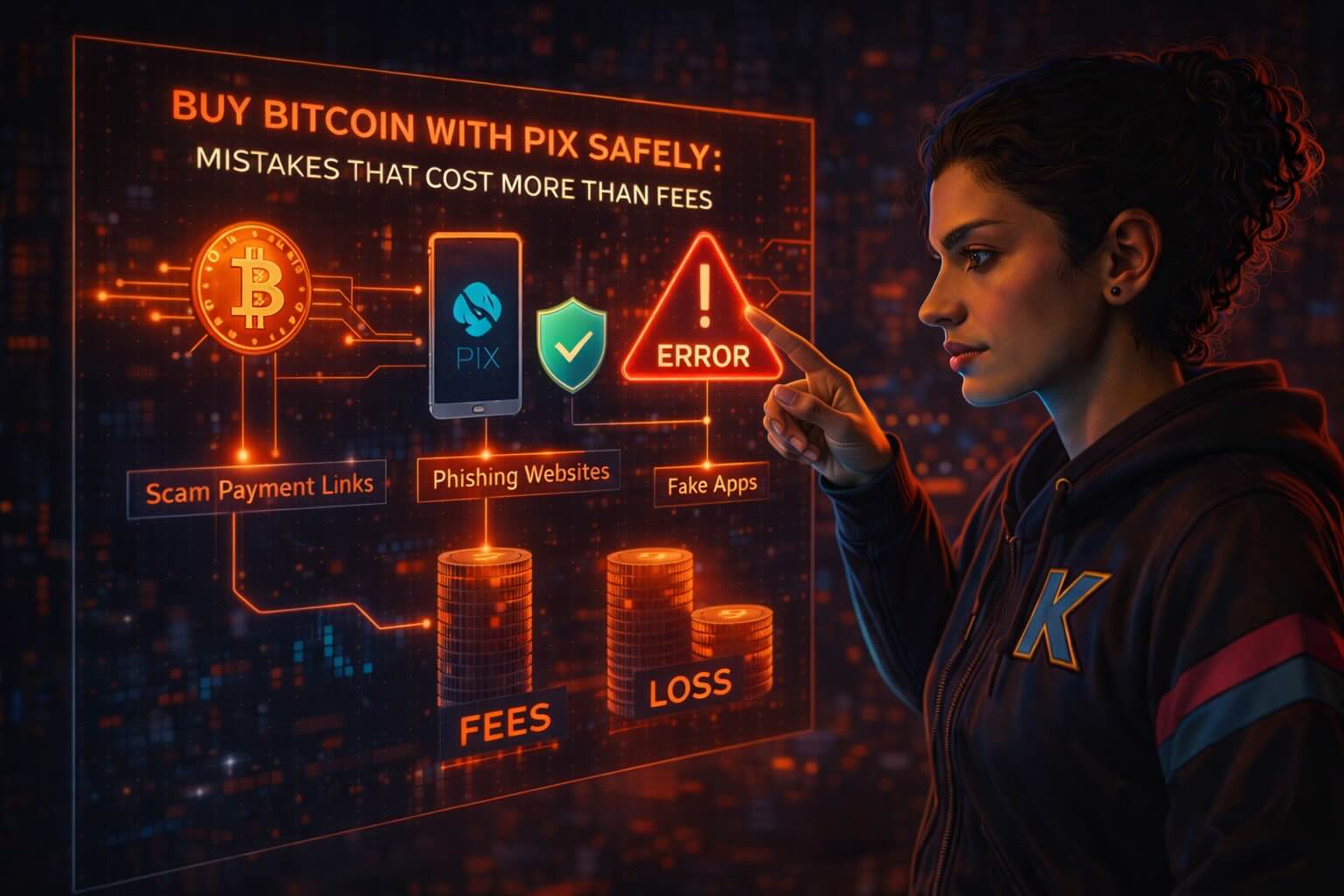
Scam prevention advice still often treats fake apps, phishing pages, and cloned support flows as cosmetic tricks. That is a mistake. The interface is not decoration. It is where authority gets manufactured.
If a victim believes they are inside a legitimate exchange screen, support portal, wallet recovery flow, or high-yield opportunity dashboard, the scam no longer needs to force a transfer through raw coercion. The interface does the persuasion. It tells the victim what is normal. It tells them what button to press next. It turns theft into a guided workflow.
That is why AI matters here. Chainalysis' 2026 scam report argues that AI is making scams more profitable not because it invents a new category of fraud, but because it improves throughput and realism. Deepfake voices, translated scripts, personalized text campaigns, and higher-volume support impersonation let operators run more believable front ends across more victims at once.
Fake interfaces are control surfaces for trust. They reduce hesitation. They reduce ambiguity. They also close the gap between the moment a victim feels doubt and the moment the operator resolves it with a fresh prompt, a fake chat reply, or a "security" instruction.
That matters in Brazil because digital payment behavior is already mobile-first and app-centric. If your financial life already happens in apps, then a fake app does not need to persuade you that apps are trustworthy. It only needs to look close enough to the app logic you already use.
This is where coverage often gets too narrow. The phrase "crypto scam" often pulls the mind toward a malicious token approval, a fake wallet extension, or a drained seed phrase. Those exist. But the Brazilian pattern is wider.
The risk breaks into four operating zones:
This starts with stolen credentials, insider access, SIM swaps, compromised employees, or phishing against bank-linked systems. Crypto enters later as the laundering route.
This includes support impersonation, fake compliance alerts, withdrawal "verification," and cloned exchange login flows. The victim thinks they are protecting funds and instead authorizes the theft.
This includes fake mentors, closed groups, romance-led investing, and "guaranteed" arbitrage or signal channels. The theft is framed as participation, not loss.
This is the part victims rarely see: mule accounts, OTC intermediaries, shell firms, stablecoin hops, and venue switching to break the trace between source and destination.
Those zones overlap all the time. A single operation may begin with impersonation, pass through Pix, settle in stablecoins, and exit through a desk that presents itself as ordinary liquidity. The categories are useful only if they help you see the handoffs between trust, payment, conversion, and laundering.
If you want a cleaner mental model for the asset side of that movement, it helps to understand why stablecoins are so useful in these networks. They are not just "digital dollars." They are friction reducers for cross-venue transfer, settlement, and cross-border movement.
Once funds leave the original account, the question shifts from recovery optimism to narrowing options.
The first problem is speed. Real-time payments compress the response window. The second problem is venue diversity. Funds can move from a bank-linked payment system into crypto, across assets, through more than one intermediary, and then into either centralized or informal channels. The third problem is narrative cover. Each step can be explained away as trading, liquidity management, settlement, or account protection.
That is why the post-transfer phase is structurally different from an ordinary payment dispute. You are no longer just contesting a transfer. You are contesting a chain of transformations.
Chainalysis also noted that impersonation scams increasingly rely on DeFi infrastructure to layer funds, while other scam forms still rely heavily on centralized exchanges. That is not a technical curiosity. It is an operational choice. Laundering paths change depending on what the operator needs most: speed, liquidity, fragmentation, or cash-out convenience.
That is also why a victim can feel confused by the evidence trail. They remember the fake support message or the urgent phone call. Investigators may later talk about USDT, bridges, or Bitcoin addresses. Both accounts are true. They are just describing different parts of the same machine.
| Scam route | Entry point | Local rail used | Crypto role | Usual psychological lever |
|---|---|---|---|---|
| Fake exchange support | Call, chat, SMS, email | Bank transfer or direct wallet move | Destination and laundering | Panic about account compromise |
| Fake investment group | Telegram, WhatsApp, social media | Pix deposit or broker transfer | Collection and redistribution | Envy, urgency, belonging |
| Banking credential theft | Phishing, insider sale, malware | Pix, linked accounts, cards | Laundering after theft | Familiar login flow |
| Fake app / cloned portal | App install or web login | Bank auth, wallet auth, or both | Theft and post-theft routing | Interface trust |
| Romance / relationship scam | Long social grooming | Repeated Pix or exchange buys | Progressive extraction | Emotional commitment |
The table shows that the "crypto" part is not always where the persuasion happens. Often it is where the money becomes hard to reverse.
That is the point many generic explainers avoid. They focus on the fraud costume. The more useful question is where reversibility disappears from the flow.
The right way to read it is backwards.
Do not begin with the token. Begin with the authorization moment. Who convinced whom? Which interface created confidence? Which payment rail moved first? Which actor turned a local transfer into a crypto transaction? Which venue added distance between the theft and the operator?
Reading it backwards changes practical behavior:
That last point matters more than it first appears. If you do not know who controls settlement, withdrawal rights, and account recovery, you do not really understand the position. A sharper grasp of custody makes a lot of scam structures easier to see before they escalate.
One trading analogy helps here. In markets, bad execution quietly erodes the outcome even when the thesis is correct. That is what slippage shows at the order level. Scam pipelines do something similar at the trust level: each small concession feels manageable until the cumulative path leaves you with a very different outcome from the one you thought you were agreeing to.
A lot of prevention lists are too generic to be useful under pressure. Decision points work better.
No legitimate support team needs you to move funds to a "safe wallet" they control. Any workflow built around panic and immediate transfer is a red flag.
If someone contacts you through one channel, verify through another channel you sourced yourself. Do not click back into the path they gave you.
Real-time convenience is exactly why attackers like the rail. Assume the response window will be short.
If money is being converted into Bitcoin, Ethereum, or stablecoins as part of an emergency, ask why portability is being introduced. Portability helps the operator more than it helps you.
Scams need compressed decision time. Real institutions can survive a pause. Fraud usually cannot.
If a basic "verification" step somehow requires app installs, ID uploads, remote access, Pix transfers, and wallet movement, you are not being secured. You are being walked through a pipeline.
The blockchain record is usually late to the story.
Brazil's payment infrastructure is not the problem in itself. Crypto is not the problem in itself. The problem is the handoff between trust-rich digital behavior and fast, portable value transfer. That handoff is where fraud compounds.
So when you hear about a crypto scam, do not reduce the story to a coin, a wallet, or a headline number. Look for the route. Look for the interface that manufactured confidence. Look for the moment a local payment problem became a global transfer problem.
That is where the scam really lives. That is also where the best chance of stopping it still exists.
This article's pipeline never opens with a wallet. It opens with a moment where a risky action feels routine, moved along by urgency, panic, or the fear of being left behind. Put a run of trades through the Kodex simulator and read the trader-psychology profile it builds from your decisions: it shows which of those levers actually shrinks your hesitation and gets you to act before you check. The money is simulated, so you meet your weak point on a dry run instead of inside someone's script.