






















































































Verified Platforms
Quick Links
Where to Stay Secure
Thank you! Your submission has been received!
Oops! Something went wrong while submitting the form.

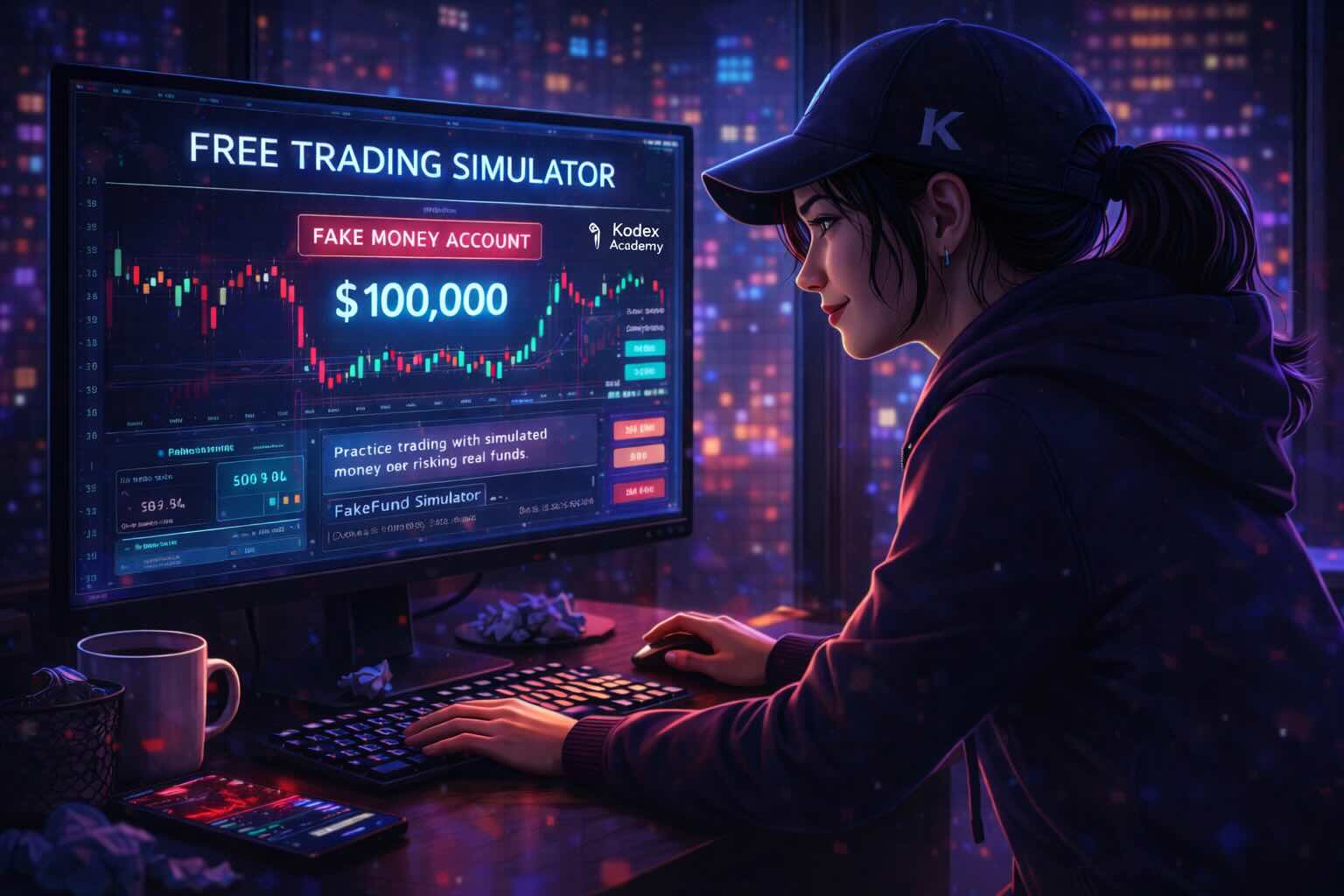
The dangerous part of trading is not ignorance. False recognition does more damage. You see a setup, think you know what comes next, and then the market forces a version of you that your chart study never had to meet.
Ava is one of Kodex's mentor-guides, and this walkthrough follows her lens through a single question: what does a crypto trading simulator actually teach once price is live and your decisions start leaving a trail?
She drags a stop a little wider than planned, watches the candle breathe against her, and tells you to notice the part that hurts: not the unrealized loss, but the instant urge to bargain with your own rules.
A lot of articles treat simulation like a padded room. Click a few buttons. Place fake orders. Learn a dashboard. Move on. That framing misses the point. A real simulator matters because it makes your process visible before real money amplifies it.
If all you want is a sandbox, almost any paper trading tool will do. If you want to see how your entries, exits, sizing, and emotional drift behave when live conditions start pressing back, the bar gets higher.
Charts teach recognition. Execution tests obedience. That gap is where a lot of avoidable damage begins.
You can understand support and resistance, know what a clean retest looks like, and still sabotage the trade the moment it becomes yours. Ava walks you through this difference without romanticizing it. The setup can be fine. The analysis can even be right. Then you size too large, panic on the first pullback, or re-enter out of irritation after getting clipped.
That is why a crypto trading simulator matters. Rather than predicting your future, it shows what your habits do under motion.
A decent simulator makes three kinds of failure obvious:
Failure pointWhat it looks like in-sessionWhat it usually meansEntry driftYou take trades before confirmation or chase after the move startsYour plan is weaker than your urgencyHold failureYou cut early on normal volatility or widen risk once price moves against youYou trust the idea less than you thoughtExit confusionYou take profit randomly or freeze when the market gives you the planned levelYou have no real exit protocol
On Kodex, the Market Simulator is built around that exact gap. The useful question is whether your actions stay coherent once the market stops cooperating.
Historical replays are clean in a way live markets are not. The candle is already complete. The path is frozen. Even when you pause and step through it, you are still looking at a solved puzzle.
A live simulator removes that comfort. The next candle has not printed yet. The move can stall. Liquidity can thin out. Momentum can fade while you are still trying to decide whether the original thesis is intact.
Ava likes this part because it strips away hindsight theater. You are no longer proving that you can explain the move after it happened. You are learning whether you can act while the outcome is still unresolved.
That changes three things.
First, timing starts to matter for real. A patient setup looks easy in retrospect. In live conditions, patience has weight. You wait, price almost reaches your level, then front-runs it by a fraction and runs without you. Or it tags you, drifts sideways, and makes you question whether the trade was ever worth taking.
Second, your tolerance for ambiguity gets tested. A static chart cannot tell you how quickly your conviction dissolves once the trade becomes messy. A live simulator can.
Third, execution quality becomes measurable. In early platform data, 100% of tracked traders showed declining consistency scores over 30 days. That does not mean everyone failed in the same way. The point is narrower: consistency gets harder to maintain than people tend to assume once they move from theory into repeated decision-making on the platform.
That is the real difference between a crypto trading simulator with live data and a replay tool. One lets you study structure. The other forces you to deal with unresolved time.
People love saying paper trading is useless because the emotions are not real. That claim sounds sharper than it is.
Fake money removes one layer of pressure. Pattern still shows up. If your process is impulsive, scattered, or revenge-driven, simulation usually shows the shape of that problem long before capital makes it more painful.
Ava points to the moments after a loss because they are rarely neutral. You tell yourself the setup was still valid. You tell yourself the next trade is the real one. You tell yourself you are just staying active. Then the click comes faster than the thought.
In early platform data, 40% of active traders showed revenge trading patterns. That number is small-sample and should stay scoped that way, but it still matters. Even without real financial pain, a sizable share of simulated participants moved into reactive follow-up behavior after losses.
That tells you something important: revenge trading is not only a money problem. It is a sequencing problem. Loss, irritation, speed, rationalization, repeat.
The same thing happens with sizing drift. You start with a plan, then your size expands after a winner because confidence feels earned, or after a loser because recovery starts whispering. On the chart, those decisions can look isolated. In a simulator log, they become a pattern.
Early exits show up too. A lot of people think they have a risk problem when they really have a tolerance problem. They can define a stop. They just cannot sit inside ordinary volatility without trying to escape it.
This is where simulation becomes more than practice. It becomes evidence.
Kodex already breaks down one of those loops in Revenge Trading Is a Loop. The point here is broader: behavior leaks through even when the stakes are synthetic.
Inside a trade, your decisions feel local. This entry. This candle. This one exception. This one adjustment that totally makes sense because this setup is different.
Step back across a session history and the story changes.
That is where Pattern Intelligence earns its place. It does not read your mind. Instead, it tracks repeated behavior across your simulated history and turns scattered moments into a visible structure.
On Kodex, that means looking across dimensions like risk tolerance, consistency challenge, time horizon, execution complexity, and trading psychology. It also means surfacing signals such as revenge trading patterns, tilt cascades, and strategy drift. Those are capabilities, not claims about every user, but they matter because they move the conversation away from vibe and toward pattern.
Ava frames it this way: while you are inside a session, you are too close to your own justifications. Pattern review creates distance. Distance is what lets you notice that your best entries happen when you wait for confirmation, your worst trades cluster after small losses, and your exits become chaotic once you feel behind.
That kind of feedback is hard to generate from memory alone. Memory protects ego. Logged behavior doesn't.
The same contrast also shows why feature-list competitors stop too early. Coinmetro emphasizes risk-free practice and platform familiarity. Gainium highlights bots, futures emulation, and reporting. Altrady leans hard on availability and exchange tooling. Useful, sure. But none of that is the same as a simulator tied to a behavioral layer that helps explain why your session keeps bending the same way.
A paper win can flatter a weak process. A paper loss has less room to lie.
That does not mean every losing trade is educational by default. Plenty of losses are just noise. The useful ones are the losses that expose a repeatable mistake before it grows fangs in a live account.
Ava will usually have you review losing trades before winners for one reason: winners are easier to mythologize. You remember the read, the confidence, the outcome. You forget the shaky entry, the bad size, or the lucky exit. A loss is less generous. It shows you where the plan snapped.
Maybe you entered early because you were afraid of missing the move. Maybe you moved the stop because accepting the original risk felt worse than pretending the trade still had room. Maybe you took profit at the first sign of green because relief mattered more than process.
Those are expensive lessons with real money. In simulation, they are still cheap enough to study.
That is why the best use of a crypto trading simulator is collecting enough honest losses to identify what keeps repeating, not paper wins for confidence.
One platform metric makes this especially sharp. In early Kodex platform data, recovery discipline averaged 48.75 out of 100, the weakest emotional-control subscore in the dataset. That does not give you a universal law. It gives you a grounded hint: after damage, process degrades fast on the platform.
If your recovery behavior is fragile in simulation, it probably gets worse once real money adds heat.
A simulator can expose twenty weaknesses if you let it. That does not mean you should fix twenty at once.
Ava keeps it narrower. Build entry discipline first. Then hold discipline. Then exit discipline. In that order.
Bad entries poison everything downstream. If you are early, oversized, or chasing, the rest of the trade has to compensate for a problem you created at the door.
Entry discipline means defining what qualifies a trade before the trade exists. Trigger. Invalidation. Position size. No improvisation once price gets close.
This is where a lot of decent ideas get ruined. You survive the wait for entry, get filled, and then start negotiating with normal market movement as if it were new information.
Hold discipline is not stubbornness. It is the ability to stay inside the original plan long enough for the trade to either work or fail on its own terms.
Exits expose whether your plan was real or decorative. A target written down before entry means something. A target invented during adrenaline means almost nothing.
Exit discipline also includes the decision to leave the trade alone instead of touching it because you are bored, relieved, or afraid to give anything back.
Why this order? Because a messy exit on a clean trade is easier to diagnose than a messy exit on a bad entry with oversized risk. Fix the front of the process first. Then the middle. Then the back.
It is there to make you harder to fool.
That distinction matters. A lot of paper trading tools are sold as confidence builders. Confidence is fine, but clean feedback is the real asset.
A crypto trading simulator earns its keep when it shows you the gap between stated process and actual behavior. Live market data makes that gap harder to hide. Behavioral review makes it harder to excuse.
Ava closes the session the same way every time. She does not ask whether the trade won. She asks whether the decision sequence held together.
That is the standard worth keeping.
Because once you can see your own drift clearly, practice stops being rehearsal. Diagnosis starts. And diagnosis gives you a chance to improve before the market starts charging full price.
Open the Market Simulator on live data and take one trade with the plan written first: trigger, invalidation, and size, all fixed before price arrives. Leave the stop alone and pay attention to the seconds after your first loss, because the urge to re-enter out of irritation surfaces whether the balance is real or synthetic. Then open Pattern Intelligence and ask Ava's question instead of the market's: not whether it won, but whether the decision sequence held together.