
































































































Verified Platforms
Quick Links
Where to Stay Secure
Thank you! Your submission has been received!
Oops! Something went wrong while submitting the form.

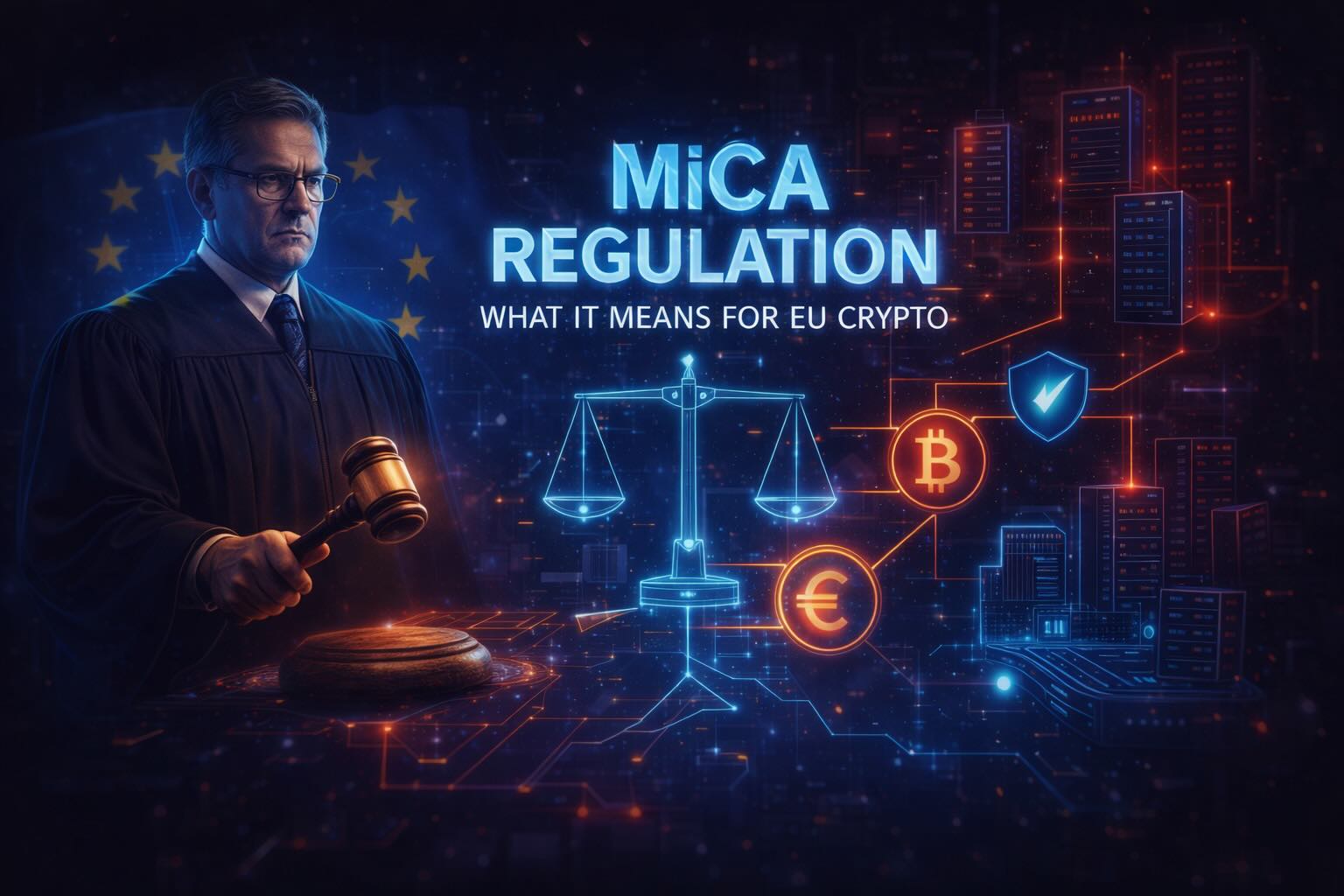
A market can stay legally alive for years while still running on borrowed permission. MiCA changes that. In the EU, crypto now has a single regulatory frame, and that means the question is no longer just what coin you are buying. The sharper question is what legal structure is carrying the service you rely on.
This is a Kodex walkthrough with Eunha and Lucia. Eunha is the Academy’s interpreter between structure and emotion, the one who turns policy noise into something you can actually use. Lucia is the skeptic at the next desk, already irritated by headlines and ready to ask what this changes in real life.
Lucia drops her phone beside the keyboard. “Every article says MiCA brings clarity. Fine. Clarity for whom?”
Eunha turns Lucia’s screen toward the center of the desk. “Start with the mechanism, not the slogan. MiCA is a sorting system. It decides which crypto activities can live inside a licensed European wrapper, and which ones lose access when they cannot.”
The framing “the EU regulated crypto” is too loose to be useful. MiCA draws lines around who can issue certain crypto-assets, who can offer services, what disclosures they owe, how customer assets should be handled, and which firms can use one authorization to operate across the bloc through passporting.
Lucia folds her arms. “So this is about companies, not users.”
“It starts with companies,” Eunha says, “but it lands on users. Access, custody, redemptions, marketing, complaints, and cross-border service all change once the legal wrapper changes.”
Before MiCA, crypto firms in Europe were dealing with a patchwork. One country had a registration regime. Another had partial guidance. Another had almost nothing. A business could be visible across Europe while the legal basis underneath it stayed fragmented.
Lucia leans forward. “That still sounds like political furniture. What changes under the hood?”
MiCA — the Markets in Crypto-Assets Regulation — is the EU’s attempt to replace that patchwork with one rulebook for in-scope crypto-assets and service providers. In plain terms, it is the difference between "available in Europe" and "authorized to operate across Europe." The regulation covers crypto-asset issuance, stablecoins, service providers, and market-abuse provisions for assets in scope. It was published as EU law in June 2023, with ART and EMT provisions applying from 30 June 2024 and the broader CASP regime applying from 30 December 2024. In practice, some member states also used transitional periods for existing providers, so the move into full MiCA authorization has not looked identical in every country.
Eunha answers without looking up. “Permission becomes more standardized. A licensed provider in one member state can passport services across the EU. Whitepapers and disclosures become formal obligations. Stablecoin issuers face category-specific rules. Exchanges and custodians become crypto-asset service providers — CASPs — with governance, capital, conduct, and safeguarding obligations.”
Lucia frowns. “So one approval can open the whole bloc?”
“For in-scope services, yes,” Eunha says. “That is why the license matters so much.”
That is the structural break. MiCA does not turn crypto into banking. It turns a large part of crypto in Europe into a supervised access layer.
MiCA applies to natural and legal persons engaged in issuing crypto-assets, offering them to the public, seeking admission to trading, or providing crypto-asset services in the EU, where those activities fall within MiCA's scope. In practical terms, the regulation matters most for two groups:
Lucia taps the table. “And what does MiCA not cover?”
“Not everything called crypto sits inside the same box,” Eunha says. “Financial instruments already regulated elsewhere stay under those older regimes. Fully decentralized activity without an identifiable intermediary may fall outside MiCA’s scope. NFTs may fall outside too if they are truly unique and non-fungible though large collections and fractionalized structures can pull them back toward scrutiny.”
That boundary matters because beginners often read “EU crypto regulation” as if every token, protocol, wallet, and meme coin is suddenly governed by one clean master law. It is not that simple. MiCA is broad, but it is not total. Some things move clearly inside the frame. Others stay at the edge, or outside it.
MiCA’s logic becomes clearer once you stop treating “crypto” as one undifferentiated category. The regulation draws distinctions because the risks are different.
Token typeBasic definition under MiCA logicMain pressure pointAsset-referenced tokens (ARTs)Tokens referencing one or more assets or baskets of valueReserve quality, redemption expectations, systemic scaleE-money tokens (EMTs)Tokens pegged to a single fiat currencyIssuer licensing, backing, redemption, payment-like useOther crypto-assetsUtility-style or other tokens not covered by existing financial lawDisclosure quality, marketing claims, and trading access
Lucia reads the table twice. “So when people say ‘stablecoin rules,’ they are usually collapsing ARTs and EMTs into one bucket.”
“Yes,” Eunha says. “But MiCA does not collapse them. A euro-pegged token and a multi-asset reference token do not create the same legal problem.”
That distinction matters because stablecoins are where many users feel regulation first. The token may still look simple on-screen, but the category behind it changes who can issue it, how reserves work, and how redemption is supposed to function. An EMT tied to one fiat currency faces a different compliance path from a token referencing a basket. The legal category shapes who can issue it, what reserves matter, how redemption works, and what extra supervision appears if scale gets large enough.
The everyday user may never issue a token. They may never write a whitepaper. But they absolutely rely on the service layer. That is where MiCA becomes concrete.
A CASP can provide services such as custody and administration, operating a trading platform, exchanging crypto for funds or other crypto, executing orders, placing crypto-assets, transmitting orders, giving advice, managing portfolios, or transferring crypto-assets for clients. Under MiCA, providing those services in the EU is no longer a matter of simply being available online and hoping brand recognition fills the trust gap.
Lucia exhales. “So if I use an exchange in Europe, the real question is whether it fits the CASP frame.”
“Exactly,” Eunha says. “And whether it is fully authorized, still within a national transitional window, or blocking certain users and products because the model does not fit cleanly.”
In practice, that means authorization, conduct obligations, prudential safeguards, complaints handling, conflict management, continuity planning, and safekeeping requirements all sit inside the regime. This is not marketing copy. It is operating architecture.
Lucia glances back at the screen. "So the app can look the same while the legal reality underneath it changes completely."
"Exactly," Eunha says. "That is where users get caught reading interface instead of structure."
Lucia swivels back toward the monitor. “Fine. Say I am not a founder. I am just holding assets on a platform. What changes for me?”
Eunha answers in layers.
First, disclosures matter more. MiCA pushes platforms and issuers toward clearer public information, including risk language that cannot hide entirely behind crypto’s old gray zone.
Second, customer asset handling matters more. MiCA’s safeguarding rules and segregation obligations are designed to reduce the chance that a platform’s balance-sheet problems pull user assets into the same hole.
Third, complaints and conduct rules matter more. The service relationship is meant to look less like “you clicked a button on the internet” and more like “this firm owes you defined conduct standards.”
Fourth, access may change. Some products, pairs, tokens, or features may disappear, migrate, or relaunch under a different legal entity because the old structure no longer works. What feels like a product change on the surface may actually be a compliance change underneath.
Lucia raises an eyebrow. “So regulation can improve clarity while shrinking choice.”
“It can,” Eunha says. “That is part of the truth people flatten. MiCA is a filter. Filters reduce ambiguity and reduce some forms of access at the same time.”
If you want the beginner version in one line, it is this: MiCA does not just ask whether a platform is popular. It asks whether the platform can carry its promises inside a supervised European legal shell.
Stablecoins were always sold on simplicity. One token. One peg. One clean idea. But the legal and operational risk was never simple. MiCA forces that complexity into view.
Lucia cuts in. “If a stablecoin keeps its peg, why should I care how the issuer is categorized?”
“Because the peg is not the whole product,” Eunha says. “The issuer, reserve design, redemption path, and legal obligations decide whether the peg is durable, interruptible, or politically fragile.”
That is why it helps to read stablecoins as more than a price peg. The market price is only the visible layer. The structure behind the token determines what happens under stress.
Under MiCA, EMTs and ARTs face different obligations. EMTs tied to a single fiat currency must sit inside a tighter payment-like framework. ARTs referencing broader baskets face another set of requirements. If a token becomes significant enough, supervisory intensity rises too. For the user, that means the same word — "stablecoin" — can hide very different legal and operational realities.
This is also where beginners make a common mistake: treating regulation as a guarantee. MiCA is not insurance. It does not remove counterparty risk. It changes how that risk is organized, disclosed, and supervised.
Lucia glances up. “What if the company is not even based in the EU?”
Eunha nods. “That is where the fantasy of borderless access runs into jurisdiction.”
MiCA does not offer a broad third-country shortcut. A non-EU firm that wants to serve EU clients generally needs an EU legal presence and authorization. It must have a registered office in a member state, conduct at least part of its services there, and maintain real management substance in the Union. The reverse-solicitation exception exists, but it is narrow and unstable as a business model.
That matters because many users assume a global exchange is globally available in the same way for everyone. Under MiCA, that assumption breaks fast. Under MiCA, the service map can split by geography, entity, and authorization status. One brand may look unified at the app layer while the legal plumbing underneath differs sharply from one region to another.
Lucia grimaces. “So the app icon stays the same while the legal reality changes.”
“Exactly,” Eunha says. “And the legal reality decides what protections, products, and obligations exist.”
This is where beginner explanations often go soft. They present MiCA as a confidence signal, then stop there. The deeper point is harder and more useful.
MiCA does not make crypto certain. It makes access more legible.
Those are not the same thing.
A token can still fail. A platform can still delist assets. A business can still retreat from a jurisdiction. A stablecoin can still face stress. A DeFi protocol can still sit outside clean regulatory packaging. What MiCA changes is the path by which services can be offered and supervised inside Europe.
Lucia goes quiet for a moment. “So if I read this right, the law is not promising that the market becomes safe. It is forcing more of the market to declare what it is — and who is allowed to offer it.”
Eunha smiles. “That is closer.”
This is the mechanism beginners need. Regulation here is not a magic shield. It is a disclosure-and-permission machine. It tells you which actors can operate, under what conditions, with what obligations, and across which borders.
If you are trying to make practical use of MiCA, there are four questions worth carrying:
Not every token or protocol interaction sits neatly inside the regulation. Some activity remains outside, partly outside, or disputed at the edges.
A CASP relationship is not the same as a token issuance question. An EMT is not the same as an ART. A regulated service interface is not the same as self-custodied DeFi use.
Brand familiarity can hide entity complexity. The app you use may route you to a local entity, a different terms-of-service stack, or a restricted product menu.
Compliance architecture can improve handling, disclosures, and accountability. It does not abolish market risk, liquidity stress, governance failure, or execution risk.
Lucia taps the list once. "So the beginner mistake is reading compliance as certainty."
"Yes," Eunha says. "MiCA can make the structure clearer. It cannot remove uncertainty from the market itself."
Lucia nods slowly. “That feels less comforting than the headlines.”
“It is more useful than the headlines,” Eunha says.
MiCA is large, but it does not settle every argument in crypto. DeFi remains hard to pin down when there is no clear intermediary. NFTs remain context-sensitive. Crypto lending was not comprehensively absorbed into MiCA’s core structure. Future guidance from ESMA, the EBA, national authorities, court decisions, and enforcement patterns will keep shaping how the edges are read.
That unfinished map matters because users tend to think regulation arrives fully formed. It does not. It arrives as text, interpretation, supervision, friction, and precedent. The law says one thing. The market learns what that means over time.
Lucia half-laughs. “So even legal clarity has its own discovery phase.”
“Always,” Eunha says.
A beginner does not need to memorize articles, recitals, or technical standards. But you do need to understand that Europe’s crypto market is moving from improvisation toward structure.
That affects which firms can stay, which tokens can scale, which stablecoin models fit, how exchanges present risk, and what kind of recourse exists when something goes wrong.
Lucia picks up the phone again, then sets it back down. “So if I had to compress all of this into one usable line?”
Eunha answers without hesitation.
“MiCA means your crypto experience in Europe is now shaped as much by legal architecture as by market narrative.”
That is the shift.
Not that crypto became simple.
The shift is that the path between you and the market now has a visible regulatory design.
MiCA sorts services by the structure underneath, not the icon on your screen. In the Kodex simulator, hold a stablecoin through a stress scenario and watch the peg sit still while the strain builds behind it, the way a calm app can carry a shifting legal reality. The funds are simulated, but the habit you are drilling (check the structure before you trust the price) is the part that carries over. Build it now, while a misread costs you nothing but the lesson.