

























































































Verified Platforms
Quick Links
Where to Stay Secure
Thank you! Your submission has been received!
Oops! Something went wrong while submitting the form.

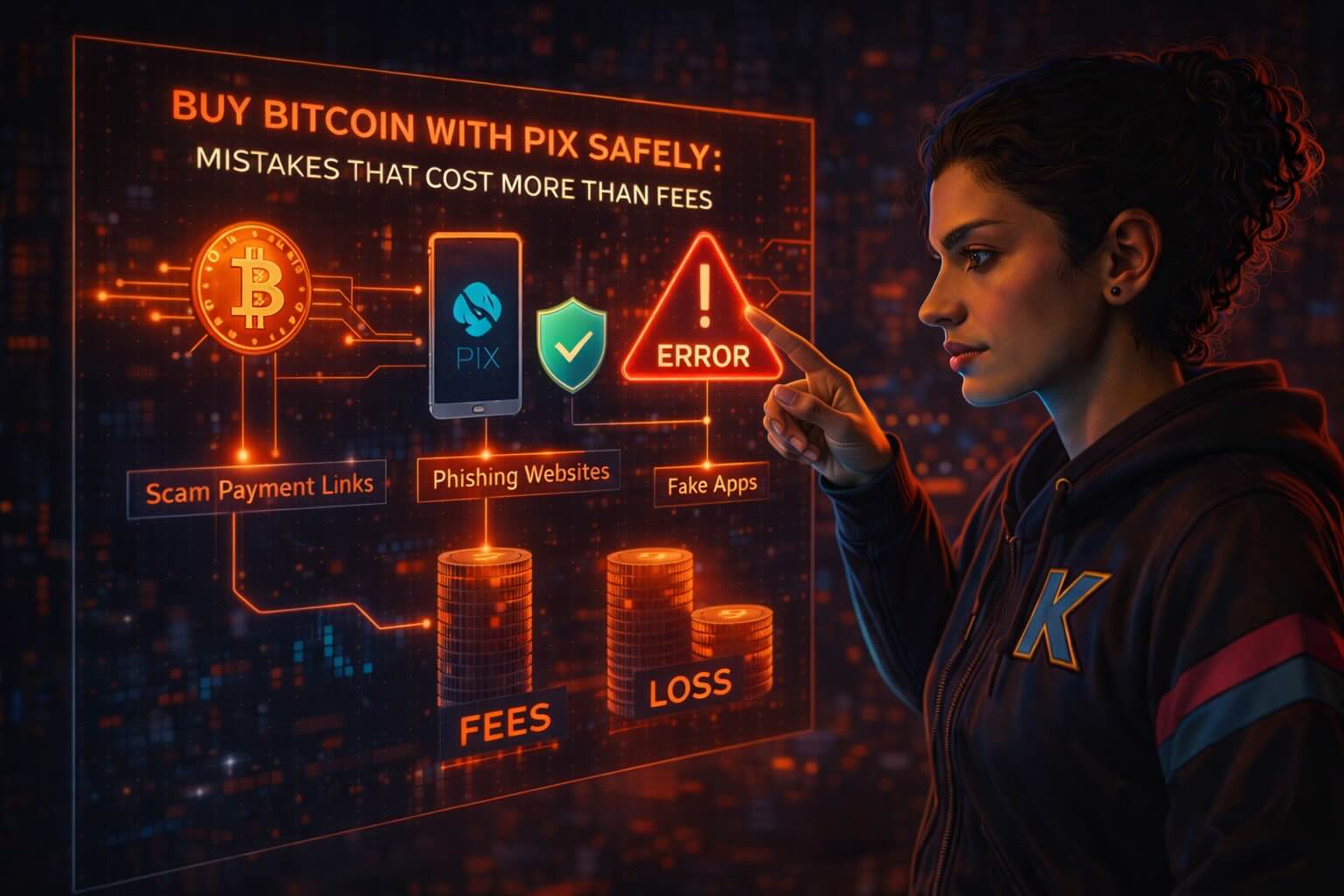
PIX made the first step easy. It did not make the full process safe, cheap, or well executed.
Lucia is the Kodex operator who watches where clean-looking flows break under pressure. Here, she walks through what it actually means to buy Bitcoin with PIX in Brazil without paying extra for mistakes that could have been avoided.
Lucia opens her banking app, sees the QR code, and pauses before sending a single real.
The pause matters. A fast deposit creates false closure: the bank confirms, the brain says "done," but the real risk chain is still open. People talk about buying Bitcoin with PIX as if PIX were the purchase itself. It isn't. PIX only moves the money from your bank to a platform. The actual buy happens after that, inside a different system, with different costs, controls, and failure points.
That distinction is where the money usually starts leaking. The fastest transfer in Brazil does nothing for you if the spread is wide, the account details don't match your CPF, the order hits thin liquidity, or the coins end up somewhere you never consciously chose.
Lucia treats the full move as four separate decisions rather than one smooth action: where the money lands, how the position gets opened, what the real cost was, and where the coins live after the order fills.
Miss any one of them and the headline promise of convenience turns into a messier entry than expected.
The Central Bank's PIX system settles BRL transfers in real time. That speed is useful. It is not the same thing as getting a good Bitcoin fill.
Lucia separates the transfer layer from the execution layer on purpose.
At the transfer stage, your bank is moving reais to a specific recipient with a specific legal identity. At the execution stage, the platform is converting those reais into your position under its own fees, liquidity, and custody rules.
That sounds obvious when written out. In practice, it is where people stop separating the steps and start treating speed as safety. Once the bank confirms the PIX transfer, the brain starts treating the important decision as finished. But funding the account is only the point where execution risk begins, not the point where it disappears.
A clean PIX deposit can still end badly: the spread may be worse than expected, the credit may be delayed because the sending account did not match the verified CPF, the order may go in at market during a sharp move, or the coins may stay on-platform by default because no custody plan existed beforehand.
Lucia treats PIX as the start of the workflow, not the proof that the workflow is safe.
The first mistake is choosing a platform because the deposit looks easy rather than checking how the full trade behaves.
A decent platform for buying with PIX safely needs more than a PIX button. Before she funds anything, Lucia checks whether the deposit path is legally clear, whether the account rules are explicit, whether the pricing model is transparent, whether the execution path is visible, and whether the custody route matches her goal.
The first check is recipient identity. The legal name and CNPJ shown in the deposit flow should match what appears in the bank app when the PIX payment is prepared. If the recipient identity looks inconsistent, the process stops there.
The second check is account ownership. Several Brazil-facing platforms require the same CPF or CNPJ on both sides of the transfer. DataWallet notes that CPF/CNPJ mismatches can cause the deposit to fail, and NovaDAX says third-party deposits do not credit. That is not a side detail. It is part of whether the route works at all.
Then comes pricing. If the platform advertises zero-fee deposits but buries the cost of execution, Lucia assumes the headline is doing marketing work. A free PIX deposit can still lead to an expensive purchase.
After that, she looks at execution. If there is an order book, she wants to see the pair that will actually be traded. If the platform works more like a broker, she wants to know how the price is formed and how much spread is embedded.
Finally, she checks custody. Buying and holding for months is a different operational problem than buying and withdrawing the same day. Before the money leaves her bank, she wants to know the withdrawal process, the network options, and any hold periods that could affect what happens next.
| Check before deposit | What Lucia looks for | Why it matters |
|---|---|---|
| Recipient identity | Matching legal name and CNPJ/entity details | Prevents sending BRL into a flow you can't verify |
| Verification rules | Same-CPF funding requirement made explicit | Avoids rejected or delayed deposits |
| Pricing model | Trading fee plus visible spread behavior | Deposit cost is not purchase cost |
| Execution path | BTC/BRL pair or clear conversion logic | Determines how much price control you have |
| Withdrawal path | Network choice, delay rules, withdrawal fee clarity | Decides whether custody stays flexible |
Lucia does not need perfection. She needs enough clarity to see where cost and friction can enter the route.
This is the kind of mistake people call annoying right before it becomes expensive.
Multiple sources aimed at Brazil make the same point: the funding account and the verified exchange account often need to belong to the same person. NovaDAX states that the bank account must match the exchange account holder and that third-party deposits do not enter. DataWallet makes the same point for Pix flows tied to exchange verification.
Lucia treats this as a systems rule, not a paperwork detail.
If the CPF doesn't match, the deposit may fail outright, the credit may be delayed while support reviews it, the money may arrive late enough for the intended entry to disappear, or the whole process may need to be repeated from the start.
For a volatile asset, delay is not neutral.
That is why Lucia checks identity fit before amount, before chart, before timing. She wants the boring layer clean first.
Her pre-transfer routine is short and boring: the exchange account is fully verified, the bank account sits under the same CPF, 2FA is already enabled, the recipient details are checked inside the banking app, and the first deposit is small enough to test the route.
That last point matters more than people admit. Lucia does not prove confidence by sending the full amount first. She proves the route works first.
Before size enters the picture, a test transfer does three useful things at once: it confirms that the recipient details match what the platform claims, shows whether the account-credit workflow behaves as expected, and exposes timing friction before the real amount goes through.
PIX is fast, but platform crediting, compliance checks, and user error still exist around that speed. A small first payment gives you a clean read on whether the workflow is actually usable.
This is not about paranoia. It is about sequence control.
If the first test amount stalls, you have discovered a process problem cheaply. If the first test clears, you still have not solved execution, but at least you have reduced transfer uncertainty before size enters the picture.
Lucia likes clean systems because they let her isolate variables. Test first. Size second.
This is where the convenience story usually starts getting expensive.
Once the money lands, the platform gives you a new decision: do you want immediate execution, or do you want price control? This is where urgency starts pretending to be clarity. The deposit is done, the interface is asking for one more click, and "just finish it" starts sounding like a good reason to buy.
NovaDAX's own guide frames the difference cleanly. A market order prioritizes immediate execution. A limit order lets you define the price and wait for the market to trade there.
Lucia does not treat those as interchangeable buttons.
A market order makes the most sense when the amount is modest relative to available liquidity, the market is calm enough that the quoted price is likely to stay close to the fill, and speed matters more than entry precision. A limit order makes more sense when volatility is elevated, the spread is visibly wide, the amount is large enough for entry quality to matter, or you already know the maximum price you are willing to pay.
The mistake is not using market orders. The mistake is using them without asking what speed is costing you.
Lucia asks one question before clicking buy: what do I care about more right now, certainty of execution or certainty of price?
If the honest answer is price, the default should not be market.
This is where the first buy often turns into a race to finish the process. The BRL already landed, the interface is asking for one more click, and speed starts feeling like completion. But urgency is not the same thing as a good entry. That is exactly how a convenient purchase becomes a more expensive one than it looked a minute earlier.
A fast move makes two bad habits show up at once: urgency and abstraction.
Urgency tells you to stop thinking and get filled.
Abstraction tells you that a small difference in entry does not matter, even when the market is moving fast enough to make it matter.
Sometimes it doesn't. Sometimes it costs more than the posted fee.
If the book is thin or the move is sharp, the effective cost of immediate execution can rise through slippage between the displayed quote and the actual fill, a wider bid-ask spread than usual, and the emotional re-entry that happens when the first fill feels bad and a second decision gets chased on impulse.
Lucia would rather miss a small burst than teach herself that rushed execution is a valid habit.
That is the problem with rushed entries: they rarely stay isolated. They spill into the next decision.
People fixate on the visible percentage because it looks measurable.
Lucia watches the spread because that is where pricing quality often gets disguised.
A platform can advertise zero-fee PIX deposits and still give you a worse Bitcoin entry than a competitor with a transparent trading fee and tighter execution. NovaDAX's guide explicitly separates deposit cost from trading fee and spread. DataWallet makes the same broader point: Pix may be the cheapest BRL on-ramp, but the real total depends on what happens once the trade is placed.
That is the mechanism this whole article sits on: the visible cost is rarely the full one.
The real cost of buying with PIX is not one number. It is the combination of deposit cost, trading fee, spread at the moment of execution, slippage created by order type and market conditions, and any withdrawal cost that appears when the coins move out.
Lucia writes it down that way because it forces the full route into view.
| Cost layer | What it looks like | Where people miss it |
|---|---|---|
| PIX deposit | Often free for individuals | They assume free funding means cheap Bitcoin |
| Trading fee | Listed as maker/taker or broker fee | They read it but do not compare total execution |
| Spread | Gap between bid and ask or embedded conversion margin | It often hides inside the quote |
| Slippage | Fill worse than expected during execution | It shows up only after the order lands |
| Withdrawal/network fee | Cost to move BTC to self-custody | It appears after the buy, when attention is gone |
Lucia does not need every platform to expose these perfectly. She needs to know they exist so she can compare the whole route instead of the marketing line.
This decision should be made before the purchase, not discovered after it.
When people skip that step, the platform ends up deciding by default.
Lucia breaks custody into three practical situations.
If the amount is small and the point is learning the funding and execution workflow, leaving the position on-platform briefly can be reasonable while you verify the route, the interface, and the withdrawal process.
If the goal is long-term holding, the custody question stops being optional. You need to know whether the position remains under exchange custody or moves to a wallet you control.
If the position is meant for later trading, transfers, or staged entries, then custody becomes part flexibility and part counterparty exposure. Lucia wants to know what operational dependence she is accepting.
The blind spot is thinking custody begins when the coins arrive. In reality, custody is already part of what you are buying. You are not only choosing exposure. You are choosing who controls it, how quickly you can move it, and what kind of dependence you are accepting on the platform you used to get in. That decision starts before the PIX transfer, while you still have the freedom to choose the route that fits your real goal.
If self-custody is the goal, check that before the deposit. Make sure withdrawals are available, understand which network options and fees apply, see whether fiat deposits trigger waiting periods, understand how address confirmation works, and decide whether a small withdrawal test makes sense.
If you do not check that first, you are not deciding custody. You are inheriting it too late.
And late discovery is expensive in the same way rushed execution is expensive: the default was already chosen while your attention was somewhere else.
That is also why a simulator matters. It lets you study execution decisions without turning every first mistake into a funded one.
Lucia's version is deliberately plain. She chooses the platform by execution quality, identity clarity, and withdrawal path rather than deposit speed alone. She verifies the account first, makes sure the bank account sits under the same CPF, enables 2FA, and starts with a small PIX test. Once the reais are credited, she checks the actual pricing screen she will use, decides whether the trade calls for a market order or a limit order, and reads spread, fee, and likely withdrawal cost as one package. Only then does she buy. From the start, she keeps the receipt, the execution confirmation, and the transaction record. And if the plan always involved a different custody setup, she moves the coins there on purpose rather than by default.
Nothing in that is glamorous. That is the point.
The market does not care that a mistake felt understandable. It still charges extra.
Lucia documents the first buy because future confusion gets expensive fast.
At minimum, she keeps the PIX receipt, the amount that landed in reais, the purchase confirmation, the fee shown at execution, the amount received, the destination and fee if the coins are withdrawn, and the date and local-currency value for her records.
That habit matters for two reasons.
First, it lets you calculate your real entry instead of the one the flow made you assume you got.
Second, it reduces future guesswork around taxes, transfers, and portfolio tracking. The first clean record is easier than reconstructing six messy ones later.
Lucia does not romanticize this. She treats it the same way she treats execution: if a workflow will matter later, build it before you need it.
Lucia closes the banking app only after the whole route makes sense.
That is the real lesson here. PIX solves the transfer problem. It does not solve platform choice, execution quality, spread, identity controls, or custody. Those decisions are still yours.
If you want to buy Bitcoin with PIX safely, stop asking only whether the transfer was instant. Ask whether the process is clean from bank account to final custody.
That is where a cheap-looking entry either stays cheap or reveals what it was hiding.
That is where a simple buy stops leaking money for avoidable reasons.
Open the Kodex simulator and buy BTC with a market order during a fast move, then read the gap between the price you were quoted and the price you actually filled at. Run it again as a limit order you set yourself, and watch it wait for the market instead of letting urgency press the button for you. The balance is simulated reais, but the spread, the slippage, and the pull to just finish the click are the real ones. Seeing that gap between the headline number and the true cost is the whole point, and here it costs you nothing to learn it.