































































































Verified Platforms
Quick Links
Where to Stay Secure
Thank you! Your submission has been received!
Oops! Something went wrong while submitting the form.

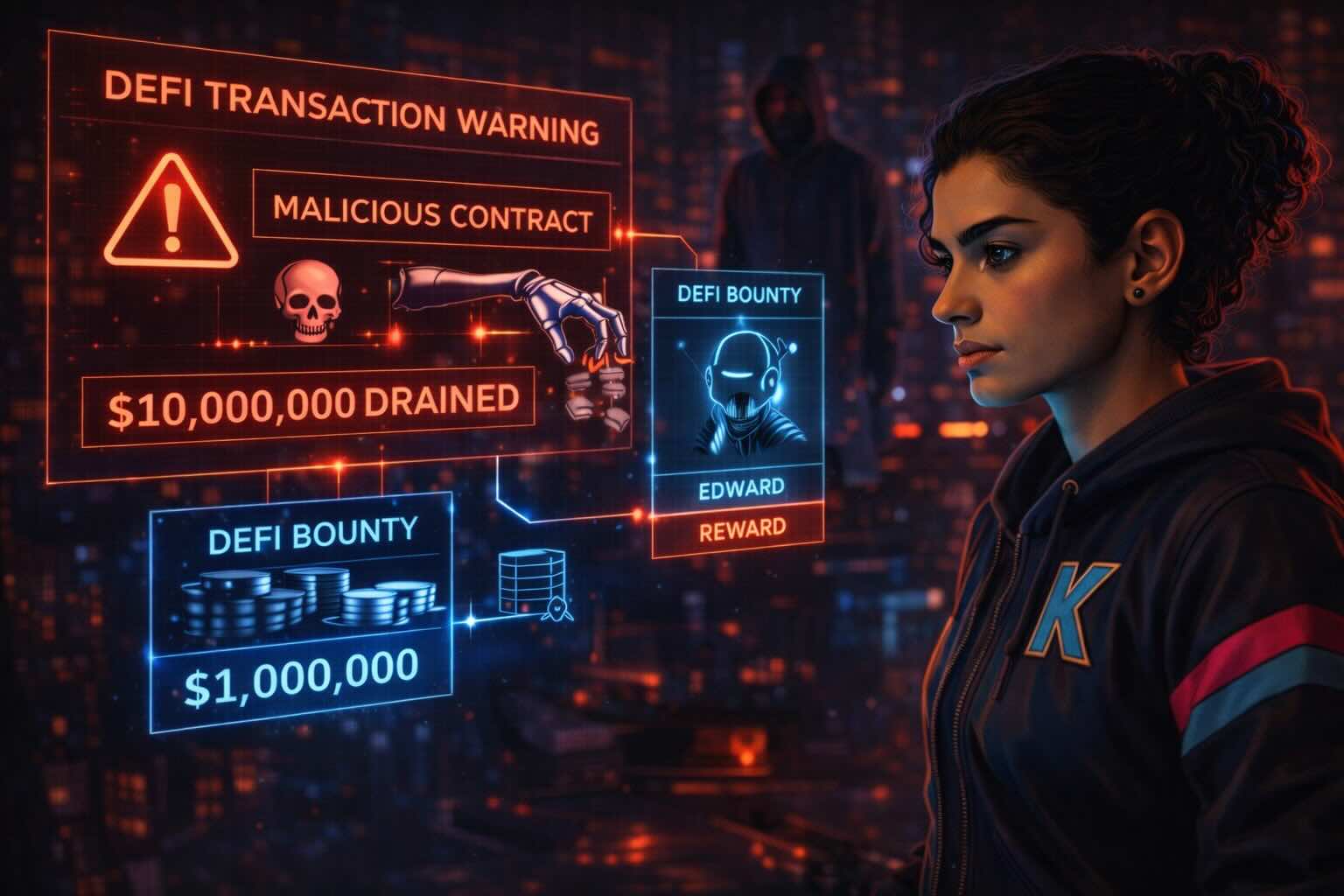
A DeFi protocol loses $2.7 million to an exploit.
Within 48 hours, it posts a public offer: return the funds and keep $270,000 — 10% — as a bounty. No prosecution. No on-chain pursuit. Just money.
In traditional finance, this gets reversed. Law enforcement, insurance, intermediaries — the whole system is designed to undo it. In DeFi, none of that exists. The transaction is final. The funds move through permissionless rails. The only tool the protocol has left is incentive design.
This is a Kodex lecture with Lilith. Twenty years in cybersecurity, most of it reading how systems actually break — not the way whitepapers say they will. What the Solv Protocol bounty shows is not a one-off gesture. It is the beginning of something most traders have never heard of: a recovery layer that sits underneath DeFi security and only becomes visible after an exploit.
Solv Protocol — yield and staking infrastructure — lost approximately $2.7 million to a smart contract exploit in early 2026. The attacker found a vulnerability, moved funds through multiple wallets, and started laundering across chains.
Within 48 hours, Solv published a bounty. 10% of the stolen funds — $270,000 — for full return. Deadline. No-prosecution guarantee.
This has happened before. Euler Finance recovered $197 million in 2023 after extended negotiation. Wormhole offered $10 million to its exploiter in 2022 — no response; Jump Crypto covered the loss. Poly Network recovered $611 million in 2021 when the attacker returned everything in what looked like a white-hat demonstration.
What makes Solv worth studying is not the size. It is the speed. Clear terms, public offer, inside two days. Not a scramble. A procedure.
The bounty works because the exploiter has a problem.
$2.7 million in stolen tokens is not $2.7 million you can spend. The funds are traceable. On-chain analysis firms — Chainalysis, Elliptic, TRM Labs — follow them across chains, through bridges, into mixers. Exchanges freeze flagged tokens. The longer you hold, the harder and more expensive it gets to move anything.
The 10% bounty is a clean exit. $270,000, liquid, unflagged. No laundering. No legal exposure.
For the protocol: get back $2.43 million or get back nothing.
Pause & Decode:
Prevention dominates most security conversations. Audits. Formal verification. Pre-exploit bug bounties. But once an exploit has happened, none of that applies anymore. The only question left is what the exploiter does next.
DeFi promises that transactions are final. The bounty says something else: transactions may be final, but incentives are not. The protocol cannot undo what happened. But it can make giving the money back the better option.
Lilith has watched this pattern across twenty years of security work. The system promises irreversibility. Then someone finds a way to make reversal worth more than theft.
Traders treat DeFi exploits as binary. Safe or stolen. Secure or compromised. Hack happens, position written off.
That misses a layer.
Since 2021, a meaningful share of DeFi exploits have ended in partial or full fund recovery. Not through law enforcement. Not through insurance. Through negotiation — public bounties, on-chain messaging, mediated settlements through security firms.
The pattern is structural. On-chain surveillance gets better, exchange compliance gets tighter, and holding stolen funds gets more expensive. The exploiter's best move shifts from disappearing with everything to taking a cut and walking away clean.
This does not make protocols safe. Recovery is not guaranteed. But "hack equals total loss" is not how these things usually end.
Pause & Decode:
Protocol risk assessment should include recovery capacity. Not just audit history. Does the protocol have an incident response plan? Has it worked with on-chain analysis firms? Can it offer a credible bounty?
Nobody asks these questions before something goes wrong. After it does, they are the only ones that matter.
Every successful bounty recovery sets a precedent. Precedents have consequences.
If exploiters learn that protocols will consistently offer 10%, the math changes. The exploit becomes forced extraction: break in, take the funds, wait for the offer, return 90%, keep 10%. The deal gets better for the attacker every time it works.
Lilith sees a problem inside the fix.
Short-term, the bounty works. Cheaper than losing everything. Long-term, it guarantees attackers a profitable exit. It makes exploitation cheaper.
This is already happening. Multiple protocols have reported incidents where the attacker's timing and behavior suggested the whole thing was designed to trigger a bounty — not to steal permanently.
The counterargument is straightforward: without bounties, nobody returns anything. Losses stay total. Users take the full hit.
Both sides are right. The mechanism recovers funds. The mechanism also makes future attacks more attractive.
That tension does not go away. It is the price of building on a system that cannot reverse transactions.
The standard framework is prevention. Has the code been audited? By whom? How many times? Were the findings fixed?
Necessary. Also not the whole picture.
Recovery capacity matters too.
Does the protocol have an incident response playbook? A team that can post clear terms within 48 hours recovers more than one still figuring out what happened.
Does it have on-chain analysis relationships? Chainalysis, TRM Labs, Elliptic trace stolen funds in real time. Having those relationships already means faster action when it counts.
Does it have the treasury to back a credible bounty? 10% of $2.7 million is $270,000. 10% of $200 million is $20 million. The number has to matter to the attacker.
Has it recovered before? Protocols with a track record tend to see more cooperative responses next time.
The Scams series covers the exploit models behind these incidents — attack vectors, social engineering, contract vulnerabilities. The Risk walkthrough maps how to size and manage protocol-level exposure.
Protocol security is not only about whether the code holds.
It is about what happens when it does not.
The protocols that survive exploits are not always the ones with the best audits. They are the ones that know what to do next.
Open a paper position in a yield or staking token, the kind Solv runs, and size it against the spectrum this lecture drew instead of the binary of safe or stolen. Ask what the position survives if an exploit hits next week and a bounty claws back only part of it, then set your size to that answer, not to the audit badge. The balance is simulated, which is exactly why you can drill sizing for recovery capacity before a live protocol asks the question for you.