





















































Verified Platforms
Quick Links
Where to Stay Secure
Thank you! Your submission has been received!
Oops! Something went wrong while submitting the form.


Every platform in the space now agrees that 2026 is the year crypto education grew up. That agreement is the first thing worth doubting.
Saying education matters is not the same as changing what learning does. When a whole industry reaches for the same phrase in the same quarter, the phrase usually arrives before the change. So the list of crypto education trends 2026 deserves a careful read, not because the shifts are fake, but because some of them are real and some are the same content wearing a new label.
Two voices at Kodex will walk the list with you. Eunha is the Interpreter. She takes a claim apart until only the working part is left. Lucia is the skeptic, the one who says out loud what you are already half-thinking. They will take each trend, name it, and ask the single question that sorts the real from the repackaged: did this change what learning does, or did it just change the label on the box?
Lucia goes first.
"Every exchange, every app, every newsletter suddenly has a learning tab," she says. "Either the whole industry found a conscience this year, or somebody noticed education is good marketing. Which is it?"
Eunha does not answer that. She moves the question.
"Both can be true, and knowing which one will not help you. The split that helps is different. Does the trend give you something you can practice and measure? Or just something new to read?"
That question is the spine of everything below.
"Start with the loudest shift," Eunha says. "For years, crypto education meant a stranger in a rented car telling you which coin runs next. That model is dying. Not because people got virtuous. Because it stopped paying."
Lucia is not convinced. "Signal groups still fill up every cycle."
"They do. But the buyer changed." A market with spot ETFs, institutional desks, and enforced regulation does not reward a hot tip the way a 2017 forum did. The cost of being wrong went up. When the cost of error rises, people stop paying for excitement and start paying for skill. The annual a16z State of Crypto review has tracked that drift toward infrastructure and real usage for years, and education tends to follow the money it is meant to protect.
"A method is slower than a tip," Lucia says.
"A tip is faster right up until it is wrong. Then you are holding a bag with no way to tell whether the idea was bad or just your timing." A method leaves a trail you can audit later. A tip leaves a feeling and a loss. That is the difference people started paying for.
So structured paths replaced the moon call. A sequence: concepts first, then mechanics, then application, with something at the end that proves you did the work. Kodex builds structured courses on that shape, and the shape is the point, not the brand.
This first trend is real. It is also the easiest to fake, because a slide deck can be put in order and still teach nothing.
That is why sequence alone is not the tell.
Lucia has a confession ready.
"I finished a course once. A good one. Then I opened a real chart with real money, and my hands did something my notes never mentioned. I bought the exact top. I knew better. I did it anyway."
"That gap is the second trend," Eunha says. "Learning is moving from reading about markets to practicing inside them."
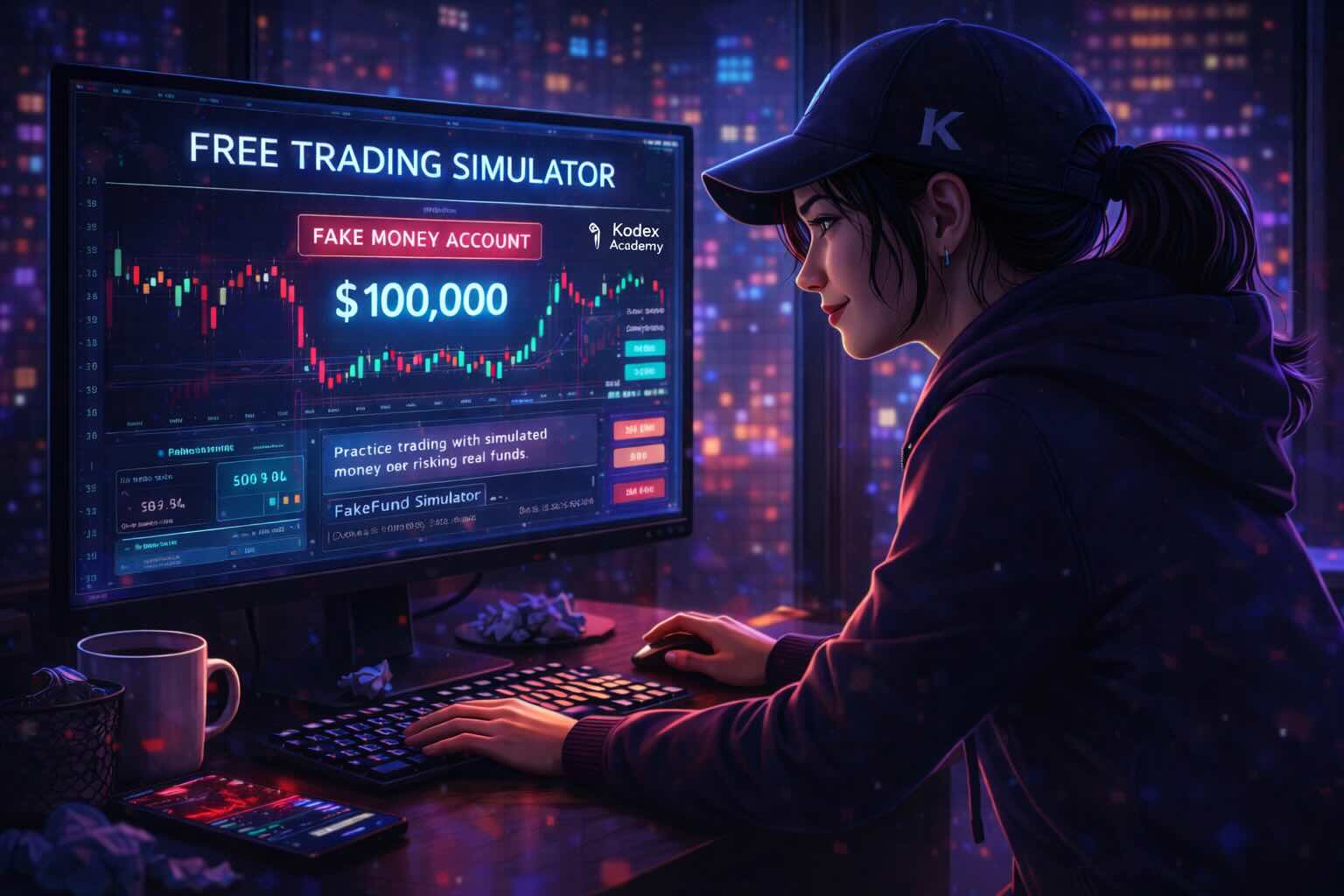
The metaphor doing the rounds in 2026 is the flight simulator. A pilot logs hundreds of hours before touching a real cockpit, so why would a beginner risk live capital on their first decision? It is a good metaphor. A simulator is what turns the metaphor into hours you can actually log.
A practice environment closes the gap Lucia just described. You meet fear, hesitation, and the urge to chase before any of it costs you rent. In the Kodex Market Simulator, 1,242 paper trades have been completed on $5,000 of starting paper capital. Each one is a rep taken somewhere a blown account teaches you something instead of emptying your wallet.
Practice is not about being right more often. It is about meeting your own reactions before the stakes are real. The first time a green position turns red in front of you, you find out whether you hold the plan or abandon it. You want to find that out on paper.
"Paper money does not feel like real money," Lucia says.
"Not at first. The habits do, though. The hand that takes a planned exit in the simulator is the same hand that takes it live." You are training the motion, not the stakes. The motion is what holds when the stakes arrive.
Reading tells you what a top looks like on a chart. Practice is where you find out what you do when you are standing on one.
Those are not the same lesson.
"The most useful thing a 2026 learning tool can tell you is not about the market," Eunha says. "It is about you. That is the uncomfortable part."
Lucia leans in. "Meaning what, exactly?"
"Meaning the leak is rarely knowledge. You know not to chase a loss. You do it anyway, at 2 a.m., the candle that took you out still glowing on the screen." Knowing a rule and interrupting yourself in the middle of breaking it are different skills, and only the second one saves money.
Behavioral finance already named the leaks. The disposition effect is the documented habit of selling winners early and clinging to losers, which is the exact reverse of what survives a market. You can read that definition in under a minute. Seeing it inside your own trade history is the part that changes behavior.
That is the shift behind tools like Pattern Intelligence. It reads a simulated trading history and surfaces the patterns you cannot see from the inside: a revenge-trading streak that always follows a red day, position sizing that creeps up the moment confidence does, a tilt cascade that opens the same way every time. Not a grade. A mirror.
Describing a bias is content. Showing you your own is feedback.
Lucia tries to skip this one. "Compliance training. The boring trend."
"Boring and load-bearing," Eunha says. "In 2026 the rules decide what you are even allowed to touch."
Whether a token is available, whether a stablecoin pays yield, whether an exchange serves your country at all: these now turn on regulation, not only on price. MiCA redrew access across the European Union. New stablecoin rules redrew what counts as safe. Read a chart perfectly and understand none of that, and you are still trading half-blind. Public resources like the SEC's investor education exist because the rule layer stopped being optional reading.
Picture the version that costs you. A token you hold gets restricted in your region overnight, and the first you hear of it is a withdrawal that will not go through. The chart gave you no warning. The rule did, months earlier, buried in language nobody bothered to make readable.
"So the boring trend is the expensive one to skip," Lucia says.
"It usually is."
This is also the one lane with a clean audience signal. When access is on the line, people search for the rule before they search for the setup.
Charts tell you what could happen. Rules tell you what is allowed to.
Now the trend everyone wants to talk about.
"AI tutors," Lucia says. "Every platform shipped one this year. Ask a question at any hour, get a personal answer. Is that the real future, or a chatbot reading the same articles back to me?"
"It does real work, and it has a hard ceiling, and the marketing blurs the two," Eunha says.
What an AI tutor does well is real, and it is not small. It compresses information. It answers at 2 a.m. It meets you at whatever you already understand and turns a dense rulebook into a plain sentence.
What it cannot do is hand you judgment under live pressure. An AI will explain position sizing in flawless prose. It cannot feel the lurch when a position you sized too large drops eight percent in sixty seconds. That reflex is earned, not downloaded.
Ask the tutor what to do when a trade turns against you, and it returns a clean answer about cutting the loss. Live, at the moment the loss is real, that clean answer has to compete with a louder voice telling you to wait one more candle. The tutor was never in that room. You are.
Micro-learning carries the same catch: a ninety-second lesson is a fine delivery truck, but depth still gets built one rep at a time.
An AI tutor is a faster index. It is not a substitute for the hours.
"Learn-and-earn," Lucia reads off the list. "Watch a video, pass a quiz, collect a token. People love it."
"Because incentives work," Eunha says. "The catch sits in what the incentive actually rewards."
A reward attached to completion optimizes for completion. You can click through a module, pass a quiz built to be passed, and walk away having learned mainly how to collect a token. The structure trained the wrong loop, and it felt like progress the whole way.
"InfoFi is the dressed-up version of that," Lucia says. "Earn for engaging with information."
"Same test applies. Pay people to read and they will read to get paid. Pay them to show a skill, and you might actually teach one." An incentive is not good or bad on its own. It points somewhere, and you want to know where it points before you chase it.
Gamification done honestly rewards the behavior you would want anyway. A leaderboard that ranks consistency teaches consistency, because the thing being scored is the thing worth building. So the question to put to any learn-and-earn pitch stays simple: is it paying you to understand, or paying you to finish?
One of those builds skill. The other builds a habit of farming rewards.
Lucia wants the verdict. "Fine. Out of all of it, what is actually different this year?"
Eunha lays it out. Every trend on the list points at something true. The split was never true against false. It is whether a platform can show you the result, or only promise it.
| The 2026 trend | What it promises | The tell that it is real |
|---|---|---|
| Structured learning | Skill over hype | A path that ends in proof, not just a finished playlist |
| Risk-free simulation | Practice before live capital | A working simulator with logged trades, not just the metaphor |
| Behavioral feedback | Learning from your own mistakes | It shows you your patterns, not a generic list of biases |
| Regulatory literacy | Knowing what you can access | Current rules tied to real decisions, not last year's summary |
| AI and micro-learning | Answers on demand | Faster access to information, honest about the reps it cannot replace |
"Every real shift shares one trait," Eunha says. "You can measure the outcome." On Kodex that shows up as 19 courses completed, 222 lessons completed, and 19 certificates earned across the platform. Small numbers. But counted, and the counting is the whole difference. A repackaged trend cannot put a measured number in front of you. It can only describe the idea of one.
Lucia, finally: "So the marketing question was the wrong question."
"It usually is. 'Does this platform care about education' has no answer you can check. 'Can this platform show me what I actually did' has one every time."
The real story of crypto education in 2026 is not that there is more of it. There is always more of it. The story is that the best of it stopped being something you consume and became something you do, and then measure.
So the next time a platform announces that education matters now, do not argue the point. Ask it for the scoreboard. Ask what it can show you about your own decisions that you could not see on your own.
Content can tell you what a mistake looks like. Only practice can tell you that the last one was yours.
This article's whole test was whether a platform can show you your own decisions or only describe them, so run that test on yourself. Take a run of paper trades in the Kodex simulator, hold one loser longer than you know you should, then open Pattern Intelligence and read back what your history says you actually did. None of it costs you rent, and the flinch when a green position turns red is still yours to keep.