






























































































Verified Platforms
Quick Links
Where to Stay Secure
Thank you! Your submission has been received!
Oops! Something went wrong while submitting the form.


Your balance is the loudest number you own, and the least qualified to answer the question you keep asking it.
A green week lands and you decide the work is paying off. A red one lands and you decide you have lost whatever you had. Between those two verdicts nothing changed about how you sized, how long you waited, or what you did after the first loss of the day. A few outcomes fell differently, one position happened to be bigger than the rest, and a number moved. You read the number as a report card on yourself.
The question underneath is not really about money. Am I improving as a trader is a question about direction, and a balance only knows where it is standing right now.
This is a walkthrough with Eunha, the Kodex Faculty voice for the inner game, the part of trading that happens in the seconds between you and a decision. She does not open a history at the balance. She opens it at two questions she refuses to let you merge: did the trading make money, and did you trade it well.
Eunha keeps those two answers in separate columns on purpose. The weeks where they disagree are the ones with something to teach.
Grading yourself by the result is not laziness. It is one of the more stubborn findings in decision research, and it has a name.
Jonathan Baron and John Hershey documented it in 1988 by handing people identical decisions and varying only how they turned out. The decision that ended well was rated as the better decision. A 2023 replication with 692 participants found the same effect at a larger size, and found it persisted in people who had just said outcomes should not influence that kind of judgment. Knowing about the bias does not switch it off. You still grade the process by the payout, because the payout is the part you can see.
Markets make that reflex worse, because they pay for things you did not do and punish things you did well. Brad Barber and Terrance Odean tracked 66,465 households at a discount broker from 1991 to 1996. The 20 percent that turned their portfolios over fastest earned 11.4 percent a year while the market returned 17.9 percent, a result the authors traced to overconfidence rather than bad luck. Activity felt like progress the whole way down. The balance never once flagged the behavior producing it.
Eunha's version of the problem is smaller and closer to home. The week that flattered you and the week that shamed you may have held exactly the same decisions. If money is the only score you keep, you have no way to tell them apart.
On Kodex the split is built into the read. The Classification Matrix in Pattern Intelligence scores your simulated trading on two separate axes, both read from what you actually did rather than from anything you report about yourself.
The Performance score answers whether it worked. That is the money question: what the wins looked like next to the losses, whether the expectancy came out positive, what the drawdown did on the way through. It is the axis the market controls, and it is the one your balance is a blurry summary of.
The Behavior score answers whether you did it right. Did the risk stay the size you agreed to when the session turned. Did entry quality hold after a loss, or did the standard quietly drop. Did the plan survive contact with a red candle, or did it get renegotiated mid-position. The market has no opinion on any of that.
Neither does your balance.
"One of those is the score the market handed you," Eunha says. "The other is the score you handed yourself, in decisions, whether or not you were watching."
Put the two scores on a grid and four kinds of month appear. Two of them are legible at a glance. The other two get misread the hardest, because in both the balance is telling a story the behavior does not support.
| Performance | Behavior | What it usually means | Where it tends to go |
|---|---|---|---|
| Strong | Strong | The result and the process agree | The only combination worth trying to repeat on purpose |
| Weak | Strong | A sound process inside an unrewarding stretch | The account is behind its own behavior and tends to catch up |
| Strong | Weak | A result the process did not earn | A drawdown waiting for the market to stop cooperating |
| Weak | Weak | Nothing is working yet, which is at least honest | Behavior first, since performance has nothing to stand on |
The lucky winner is the dangerous one. Green month, rules broken all the way through it, size climbing after every loss, and the reward arrived anyway. So the behavior gets ratified. It comes back at larger size in a month that does not hand out the same gift, and the giveback runs bigger than the month that funded it.
The market paid for something you did not do.
The disciplined loser is the one Eunha would rather sit with. Risk held, exits taken where they were planned, entries that kept their standard through a losing streak, and an account that is still red. It is a miserable place to stand and a good place to be standing, because the only thing missing is a market that pays. That arrives on its own schedule. The behavior does not.
Sitting above both scores is your Trader Identity, the archetype the read assigns you. It is not a personality you select from a list. It is a behavioral signature, assembled from what you already did. How long you hold. How you size after a red day. What you reach for when a position turns against you, and which hour of the session tends to catch you.
Pattern Intelligence sorts that signature into nine archetypes and tracks it across ten behavioral dimensions of your simulated history. The label matters less than where it came from. A personality quiz asks how you intend to trade, and you answer as the person you meant to be. An archetype is assembled from timestamps and position sizes, which do not care what you meant.
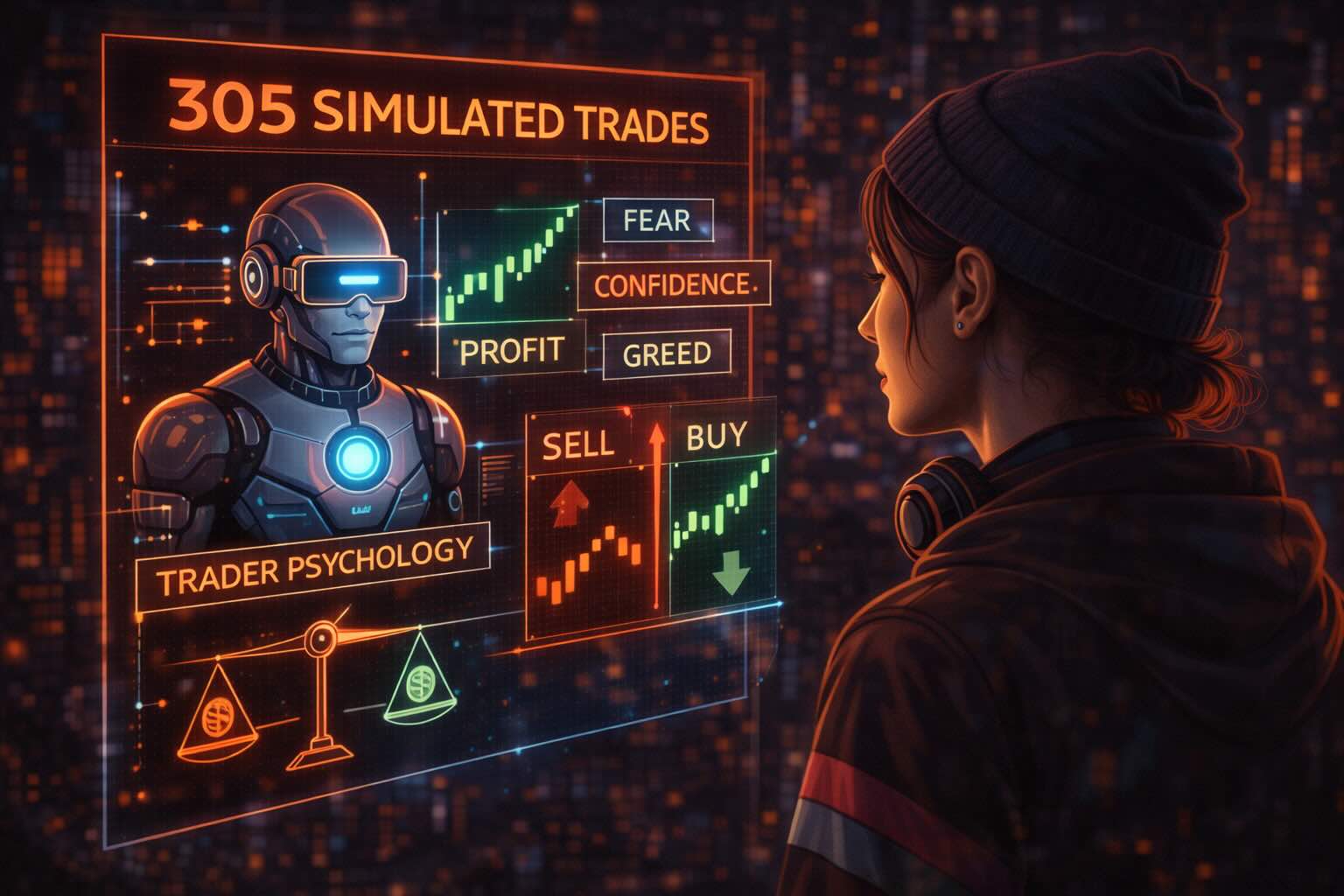
What 305 simulated crypto trades revealed about trader psychology landed on the same split from the other direction. The story was never in any single outcome. It was in what happened after losses, how risk got distributed, and whether behavior repeated cleanly enough to be called a pattern.
The snapshot runs out here. A score tells you where you are standing, and says nothing about which way you were walking when the picture was taken. That missing piece is the whole question.
Your Evolution is the second panel, and it tracks the 30-day trend of eight metrics: win rate, expectancy, drawdown, risk-reward, emotional control, tilt, consistency, and entry quality. Same underlying behavior, plotted over time instead of flattened into a grade. Where the Classification Matrix gives you a position, Your Evolution gives you a slope.
A score is a photograph. The trend is the derivative.
You cannot feel that slope from inside a single week, which is the practical reason the panel exists. Recent results dominate the memory, so three good sessions read as a turnaround and two bad ones read as collapse, and both readings are noise dressed as evidence. Thirty days of emotional control drifting downward while the balance climbs is not something introspection can catch. It only becomes visible once it is plotted.
Eunha watches the direction of the behavior metrics before she looks at the money ones. Tilt rising and consistency falling under a green month is a specific warning, and it arrives well before the balance agrees.
Eunha will not rank two accounts by their scores, and she is direct about why. Two people can share an identical number and be in opposite situations: one is climbing toward it, one is sliding away from it, and the score itself cannot tell you which is which. Give them both a quarter and the distance between them is wide enough to be a different account.
Time served does not settle it either. When Ericsson's classic violinist study was replicated in 2019, accumulated practice hours explained about 26 percent of the difference in skill, not the near half the original reported. Among the elite players, the hours did not separate the best from the merely good at all. Repetition is not the mechanism. What you repeat is, and whether anything tells you which way it is trending.
This is why the pair of panels works better than either one alone. The Classification Matrix tells you where you are and which of the two scores is doing the lying. Your Evolution tells you whether the work is working. Watching only the first is how a good score quietly rots. Watching only the second is how you celebrate a slope that started from nowhere.
Start with the behavior slope, not the performance one. Behavior is the axis you control, which makes it the only one where a trend is unambiguous news about you rather than about the market. If entry quality and consistency are rising while your balance is flat, you are improving, and the account is late.
Then read the performance slope as confirmation rather than as the grade. Expectancy climbing behind rising behavior scores is the pattern you want, in that order. Expectancy climbing while emotional control and tilt fall apart is not a win. It is the lucky winner quadrant playing out in slow motion, and it resolves the way that quadrant resolves. "Take the second one in the wrong order," Eunha says, "and you will spend a month defending the exact habit that is going to cost you."
The behavior that breaks both slopes at once is the one that feels like recovery while it happens. Revenge trading is a loop rather than a lapse. It hits size, entry quality, tilt, and consistency in the same session, which is why it surfaces on a trend chart long before you would admit to it. The rest of the damage is ordinary process leakage. Seven crypto trading mistakes worth avoiding are versions of one thing. The account rarely breaks because the market read was wrong. It breaks because the process broke first, and the result only showed up later.
Stop grading yourself on the outcome.
Grade the process and its direction instead. Those are the two things that belong to you, and the only two that compound.
You have been asking a balance to grade your process, and it has never once been in a position to answer. Hand the question to the record instead: the Trading DNA read splits your Performance from your Behavior, names the archetype underneath both, and takes about two minutes with no signup. Then run a week of trades through a $5,000 paper account in the simulator and check the slope rather than the number at the bottom, while the answer is still free.